

.svg)
Free Survey
Our People
Our Thinking
Shop

You can expand your thinking-and still be the bottleneck. That realization took me a few years to see that clearly.
Four years ago, I wrote about becoming a “switch hitter.” The metaphor came from baseball.
In Major League Baseball, only about 13% of players bat from both sides of the plate. Switch hitters do it. They do it for options. Facing a right-handed pitcher? Bat left. Facing a lefty? Switch sides. It’s not easy. Most players have a dominant side, and batting averages often drop when they hit from the other.
But the adjustment gives them an edge. The same is true for leaders.
Most leaders are dominant-handed — not physically, but cognitively. We rely on familiar “thinking patterns." We lean on our strongest instincts. We default to what’s worked.
As an executive coach, I often hear leaders say they want to think bigger or be more agile. What they’re really asking is how to move beyond the thinking patterns that got them there.
The original Switch Hitter idea was about expanding how we think. Moving from fixed thinking — the need to be right — to expansive thinking — being willing to learn. That requires “deliberate practice.” Just like hitters train against different pitches, leaders need to practice thinking beyond their natural strengths. This is possible throughout our lives; the brain continuously rewires itself through experience and repetition.
In the original article, I described a simple way to stretch your thinking: the Thinking Pattern℠ — four lenses leaders can use to approach challenges:
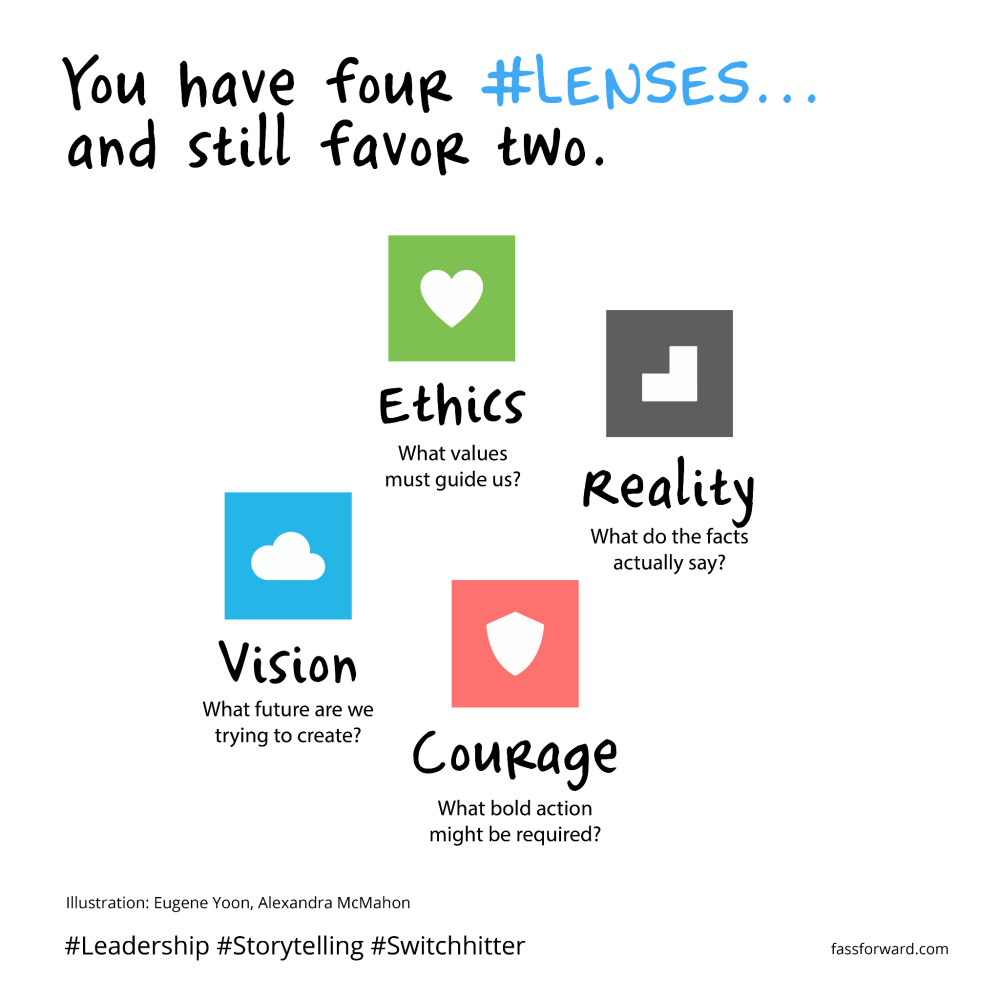
• Vision – What future are we trying to create?
• Courage – What bold action might be required?
• Ethics – What values must guide us?
• Reality – What do the facts actually say?
Most of us naturally lean on only two of these, like a dominant batting side. Switch Hitter 1.0 was about building the mental dexterity to use all four. And that lesson still holds, but experience has added something important.
Expanding your thinking improves your range. It doesn't improve your scale.
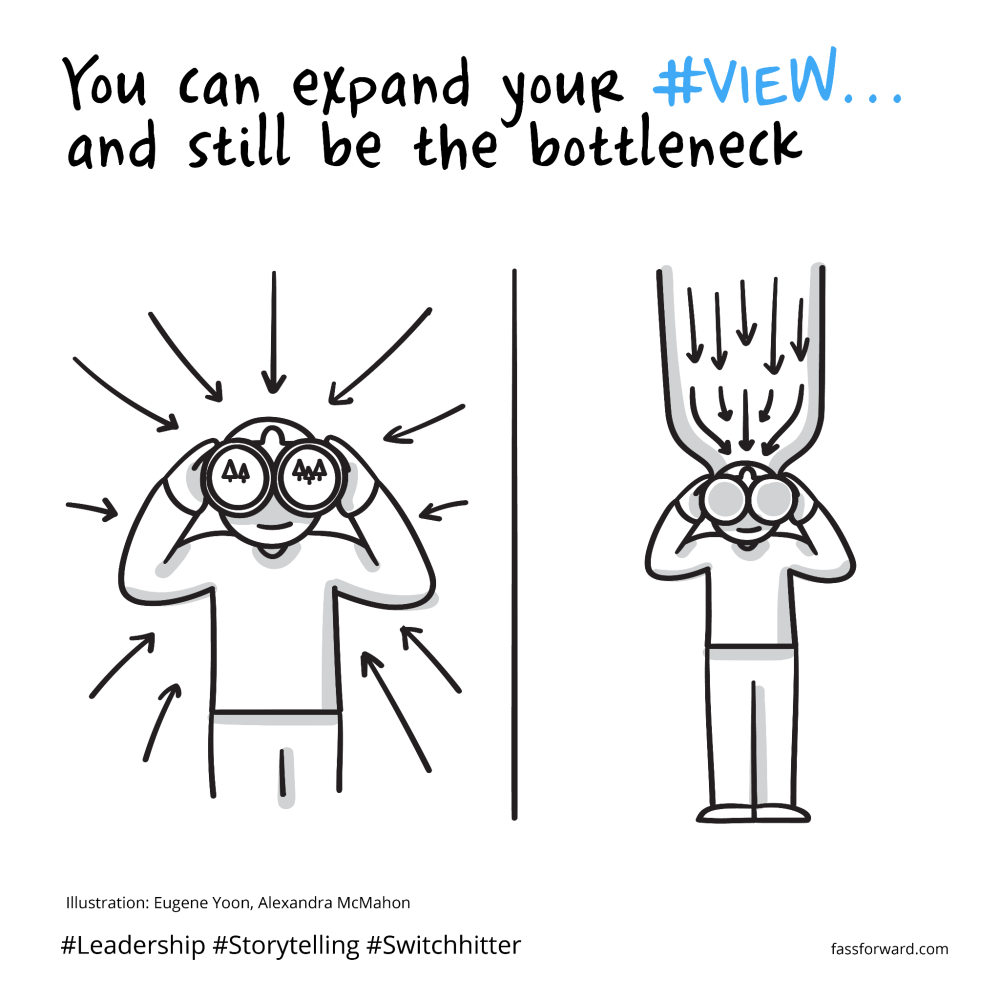
You can see more angles… And still centralize decisions.
You can welcome new perspectives… And still be the filter.
You can think expansively… And still exhaust yourself trying to carry it.
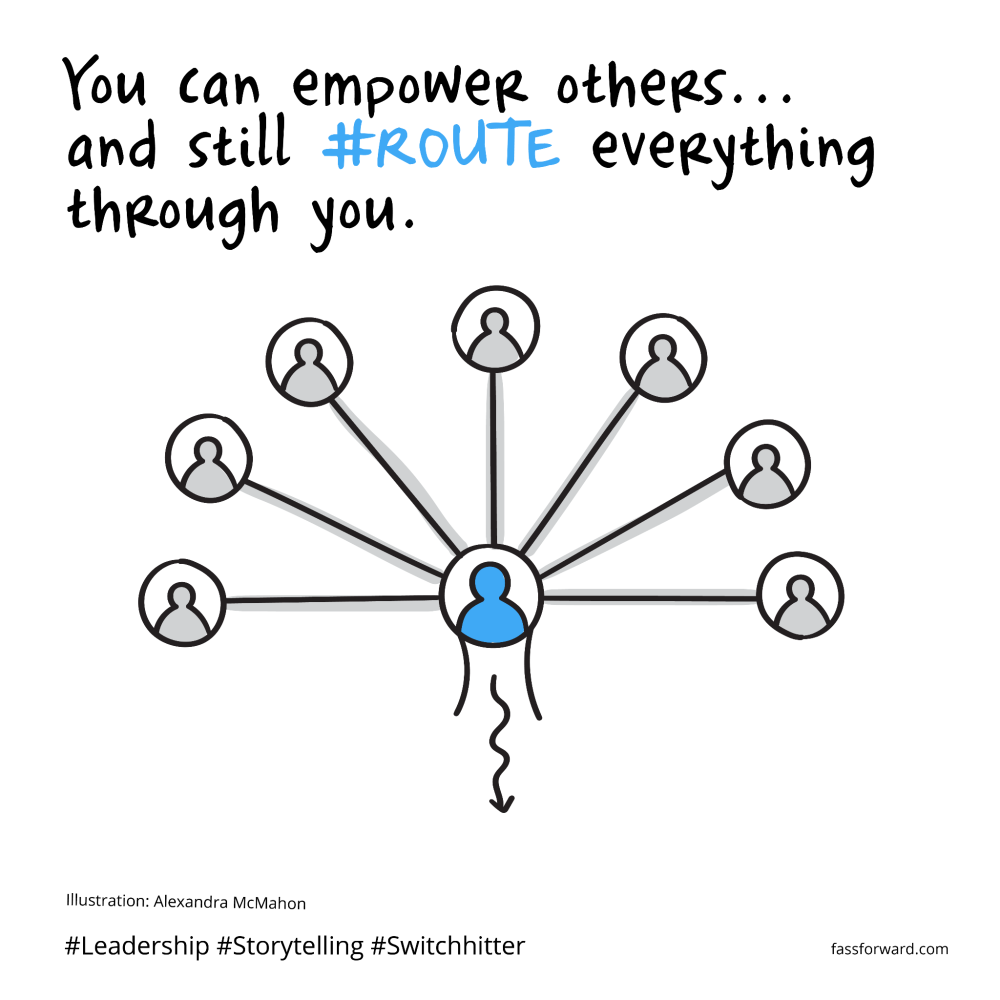
That’s the trap. Individual agility feels like progress. But organizational agility requires distribution. Agility doesn’t scale through the leader. It scales through the system.
Which brings us to Switch Hitter 2.0.
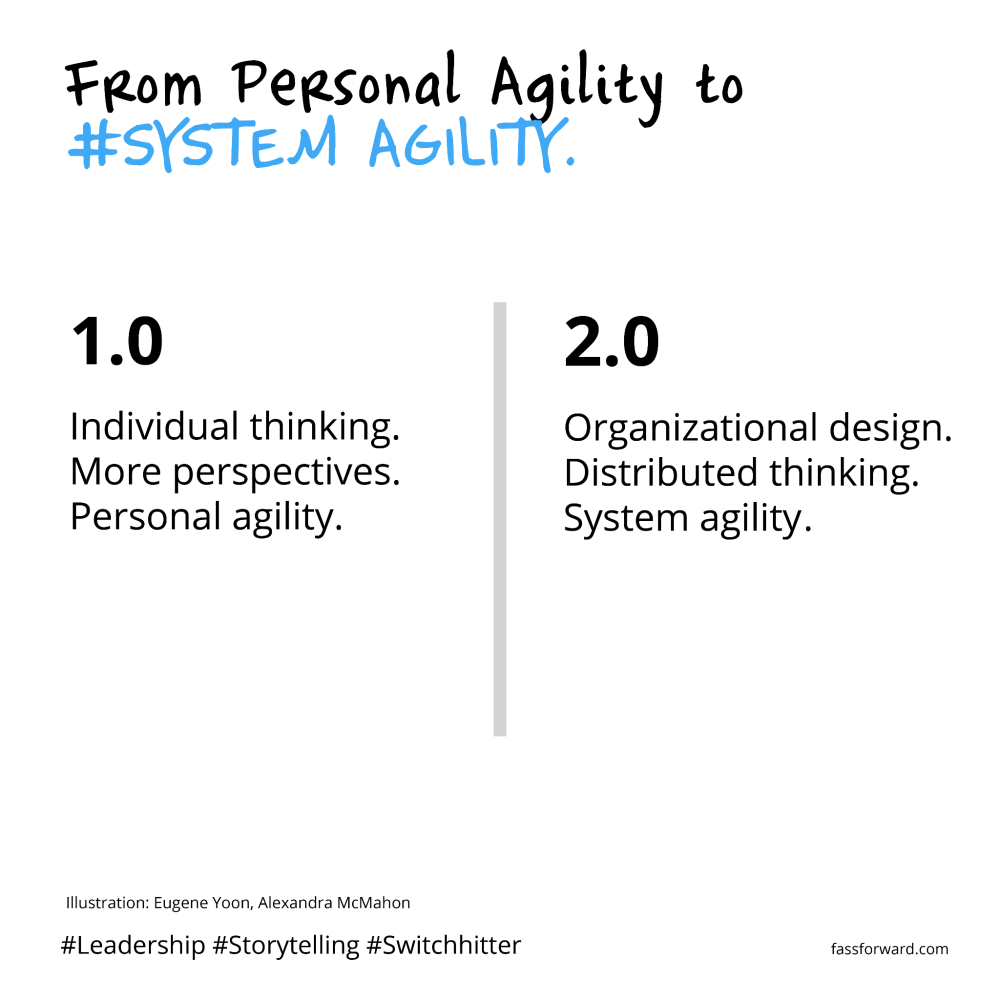
The first version of the idea focused on the leader.
Your thinking.
Your adaptability.
Your ability to approach problems from multiple perspectives.
But leadership eventually runs into a structural limit. No matter how agile your thinking becomes, if every decision, interpretation, or escalation still runs through you, the organization moves at the speed of your attention. That’s not agility. That’s dependency.
Switch Hitter 2.0 shifts the focus from the individual to the organization.
The question is no longer just: How do I expand my thinking?
It becomes: How do I build a team that can think through a problem without me?
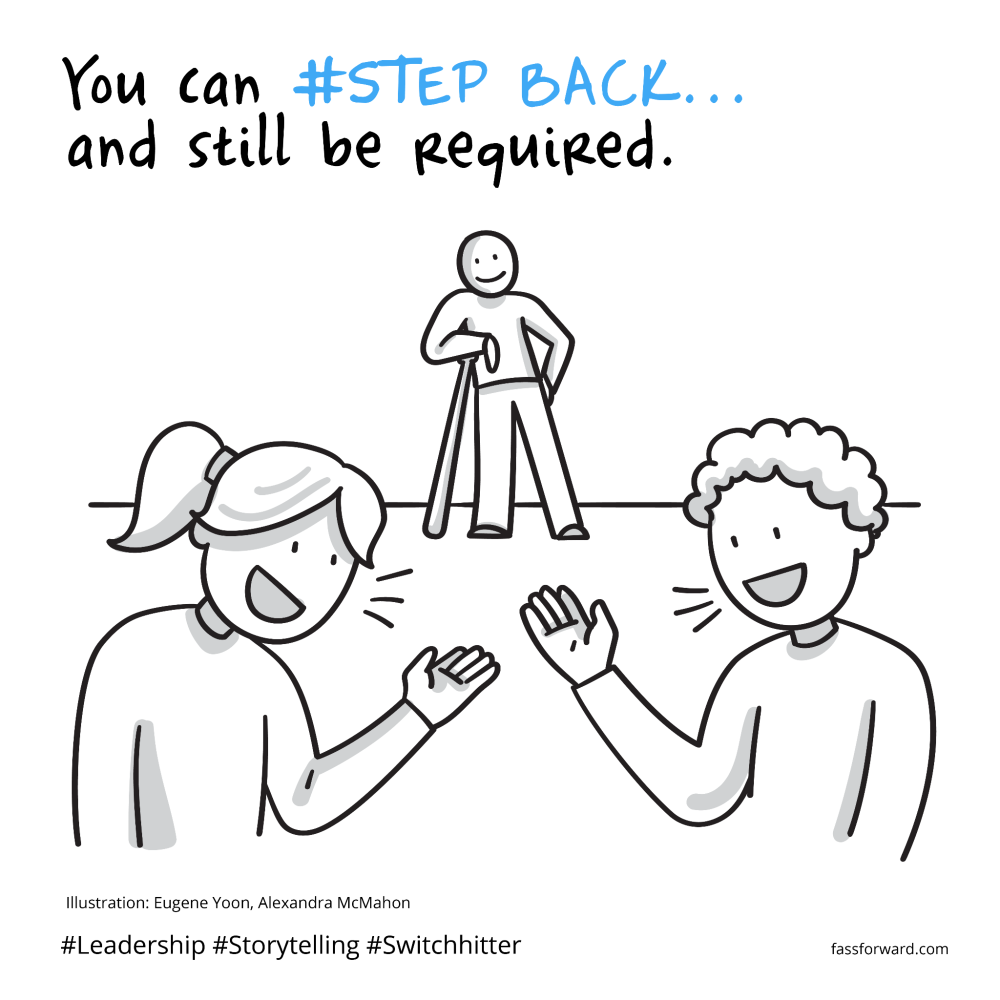
Not just developing cognitive flexibility —but designing conditions where flexibility becomes cultural. What does that actually require? It’s not a mindset shift. It’s a design shift. It shows up in what you stop owning, what you make explicit, and what you reinforce repeatedly.
• You clarify which decisions no longer come to you — and you hold that line, even when it’s uncomfortable.
• You make your thinking visible — not just the answer, but how you weigh vision, courage, ethics, and reality — so others can apply it without you.
• You replace escalation with structured conversation — where trade-offs surface, not sent up for approval.
• You reward people for thinking, not just agreeing — especially when they reach a different conclusion than you would have.
Teams don’t become agile by being told to think differently. They become agile when the environment requires it.
Where:
• People surface trade-offs without waiting.
• Context travels without translation.
• Decisions move without escalation.
• Multiple thinking patterns show up in the room — even when you’re not there.
In other words, agility stops being a leadership trait and becomes an organizational capability. Switch Hitter 1.0 expanded the mind. Switch Hitter 2.0 expands the organization. The first builds capability. The second builds resilience at scale.
The real question for leaders becomes this: Can you switch sides…and have you built a team that doesn’t need you at the plate every inning?
The first builds capability…the second builds capacity. Because expanding your thinking makes you a better hitter. Expanding the organization builds a better lineup.

And organizations move faster when people can step up to the plate.

Most companies don’t have a product problem. They have a value creation problem.
If growth depends on you pushing, you don’t have momentum. You have effort. And effort doesn’t scale. Strong leaders know how to build. Enterprise leaders know how to create value.
There’s a difference. product depth. operational rigor. technical excellence. Those build strong solutions. But organizations don’t scale on solutions alone. They scale on value creation.
Commercial vision is the shift from: “What should we build?” to “What creates measurable value?” Revenue. Retention. Margin. Market position. Timing. Without that lens, teams optimize for output. With it, they optimize for impact.
This dynamic surfaced recently in a coaching conversation with a Vice President of Product at a technology company. What it revealed was that two very different conversations were happening at the same time.
You can see the difference in meetings.
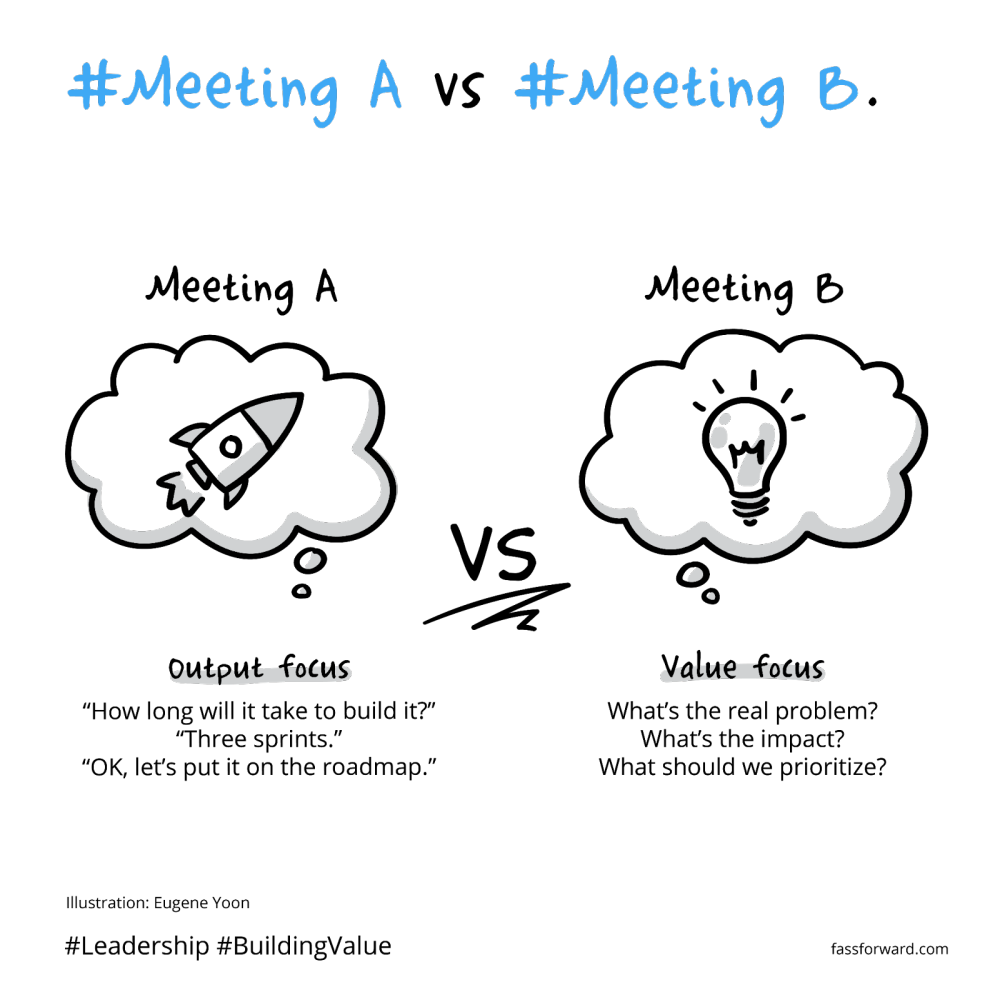
“We’re losing some enterprise deals; they want a custom reporting dashboard.”
“How long will it take to build it?”
“Three sprints.”
“OK, let’s put it on the roadmap.”
“We lost three enterprise deals; they want a custom reporting dashboard.”
“What was the value?”
“About $1.8M ACV.”
“What’s the evidence?”
“They told us reporting was the issue.”
“Is that why they didn’t sign… or what they said at the end?”
“…It came up late.”
“So what problem were they trying to solve?”
[Silence.]
“If we build this, what do we delay?”
“Improving onboarding.”
“And which one grows the whole base?”
“…Onboarding.”
Which conversation feels more familiar?
If it's Meeting A, you’re optimizing for output. If it’s Meeting B, you’re optimizing for value.
The feature/value dilemma is the difference between tactical reaction and strategic intention. Between short-term appeasement and long-term growth. A feature is output. Value is outcome. A feature answers: “What can we ship?” Value answers: “What moves revenue, retention, margin, or position?”
Organizations that scale build something different. They build value engines.
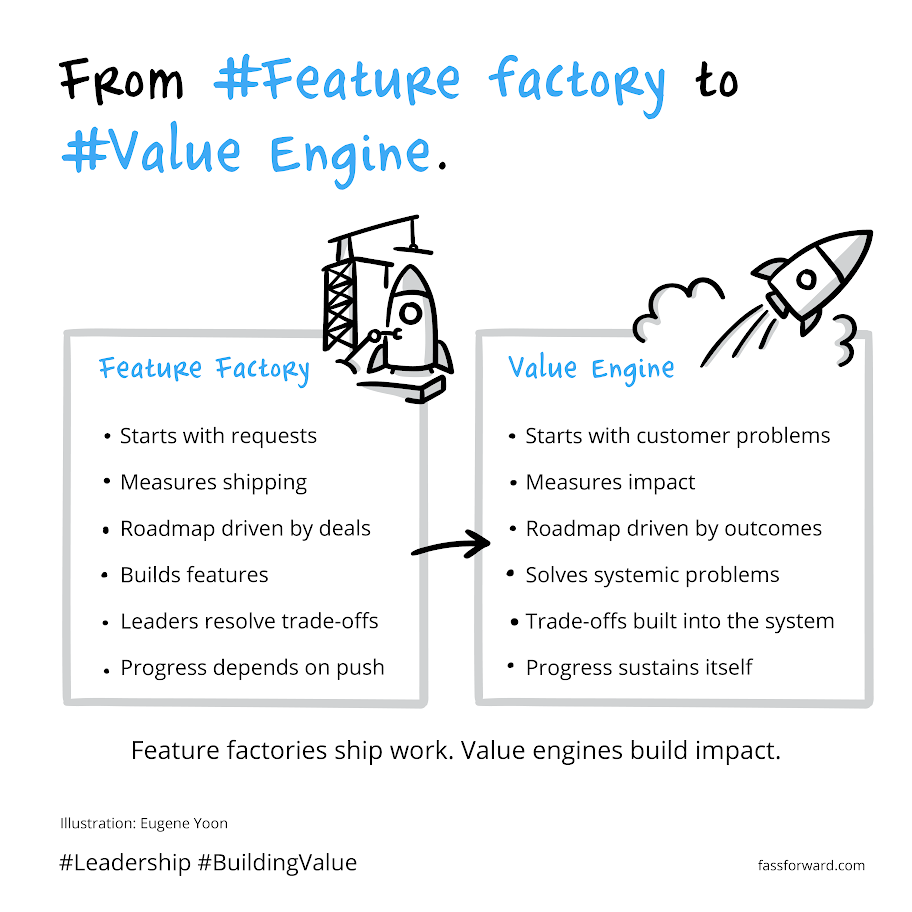
A value engine does one thing:
It converts customer problems into business outcomes. Not activity. Not features. Outcomes. Instead of starting with a roadmap, teams start with the impact they want to create.
The thinking shifts from:
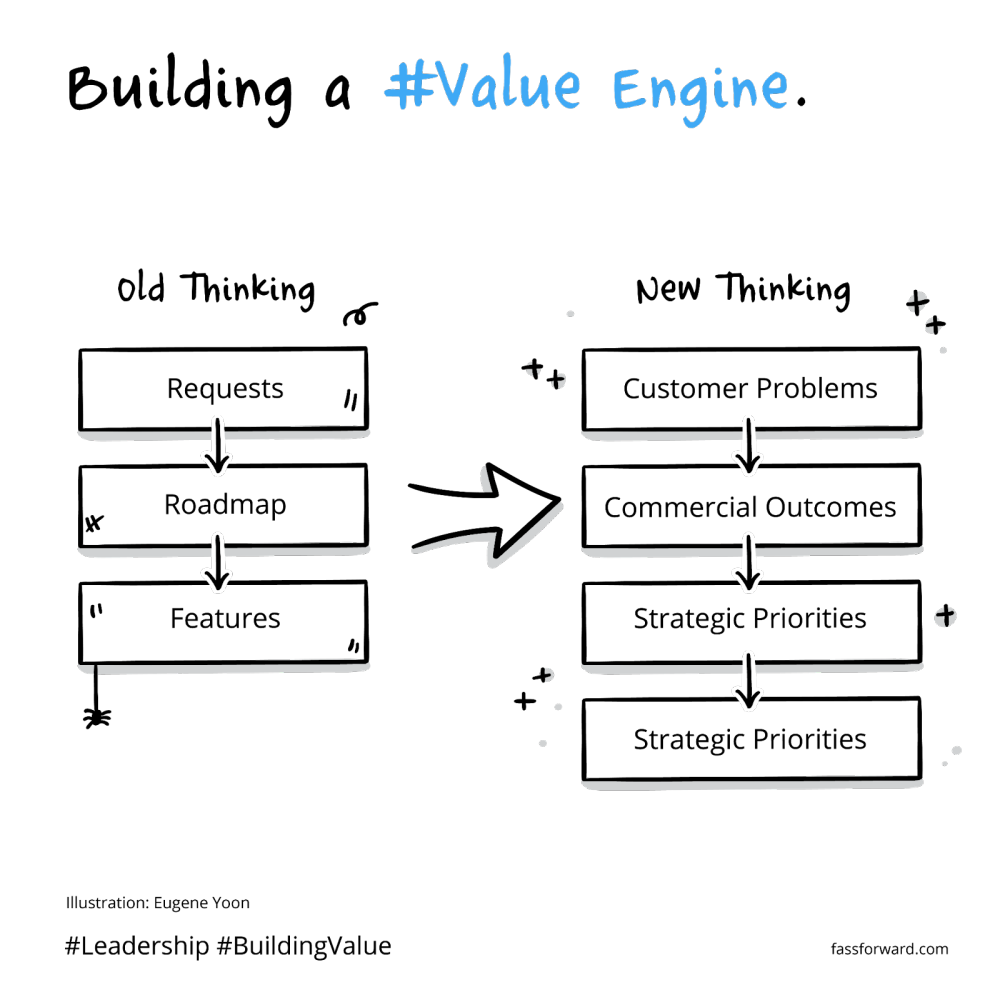
Features become tools. Value becomes the goal. Teams begin debating questions like:
Over time, value creation becomes systematic, not incidental. But most organizations never reach this point. Not because they lack talent. Because they drift into feature factories.
Three leadership habits usually cause it.
Most organizations celebrate shipping.
“We released twelve features this quarter.” “Velocity increased.” “The roadmap is full.”
Those are measures of activity. Teams quickly learn what success looks like. If shipping is rewarded, they optimize for shipping.
Value engines ask a different question.
Not:
What did we release?
But:
What changed because we released it?
Did adoption increase? Did churn decrease? Did sales velocity improve? Did onboarding accelerate?
The conversation shifts from production to impact.
A deal is lost. Sales says:
“They needed X.” Product builds X.
But what appears late in a deal cycle is rarely the root problem. It’s the final objection raised in negotiation.
The real issue might have been:
When companies build features from deal feedback, the roadmap slowly becomes a list of objections.
Value engines pause and ask different questions:
Only then does work get prioritized.
This is where scaling begins to break.
In early growth, leaders often:
It works. For a while. But eventually, the organization becomes dependent on that intervention.
Progress requires:
When they step away, momentum slows. The leader has become the engine.
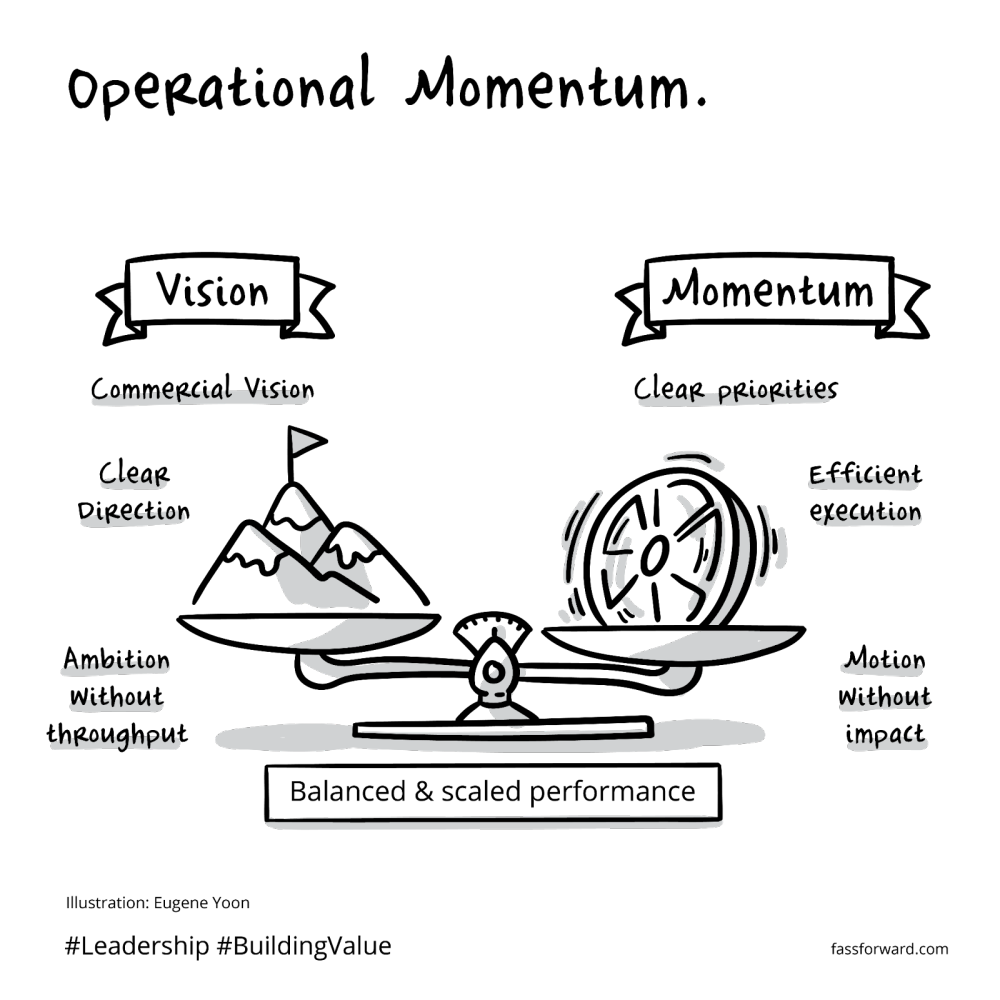
Operational momentum looks different. Priorities are unmistakably clear. Sequencing reduces friction. Decision rights are understood. Context is widely shared. Progress sustains itself. Momentum is when the flywheel turns without constant force. Commercial vision sets direction. Operational momentum sustains acceleration. One without the other creates an imbalance. Vision without momentum creates ambition without throughput. Momentum without vision creates motion without impact. Together, they separate companies that perform from companies that scale.
Ask yourself a few questions.
When a deal is lost, what happens first?
A) The requested feature goes onto the roadmap.
B) The team analyzes the underlying problem and commercial impact.
When teams debate priorities, what dominates the discussion?
A) Delivery timelines and engineering capacity.
B) Revenue, retention, and customer impact.
When you step away for two weeks, what happens?
A) Progress slows while teams wait for decisions.
B) Work continues within clear priorities and decision rights.
If most of your answers were A, you're operating a feature factory.
If most of your answers were B, you're building a value engine.
The real question isn’t whether you’re building great products. It’s whether you’re building a value engine. Because if the system slows when you stop pushing, you don’t have momentum. You have effort. And effort doesn’t scale.
Take the full survey on Typeform: https://fassforward.typeform.com/to/YMUMhQ3w

TLDR: Executive coaching often falls short not because leaders resist growth, but because coaching becomes disconnected from the business, poorly measured, and too slow to meet real leadership moments.
Executive coaching has never been in more demand.
According to Mordor Intelligence, the market is expected to grow from around $100 billion today to $175 billion by 2031. While the industry is rapidly expanding, the standard of executive coaching often falls short of what is necessary for true professional transformation.
As the demand for high-level guidance grows, it is critical to elevate the quality of coaching to deliver measurable, high-impact results. When I stepped in to lead fassforward's executive coaching practice in 2017, this was my primary goal.
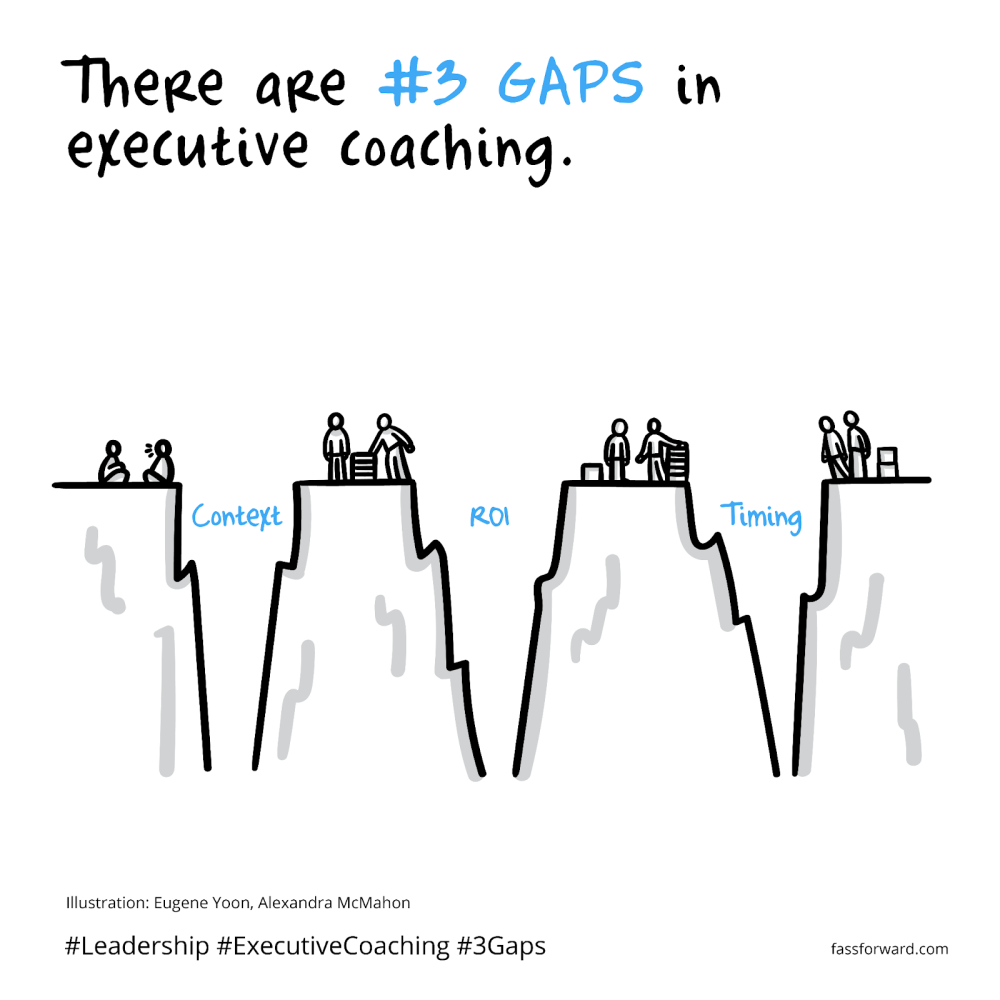
I consistently found 3 gaps in Executive Coaching.
With the proliferation of coaching, they are more prevalent than ever.
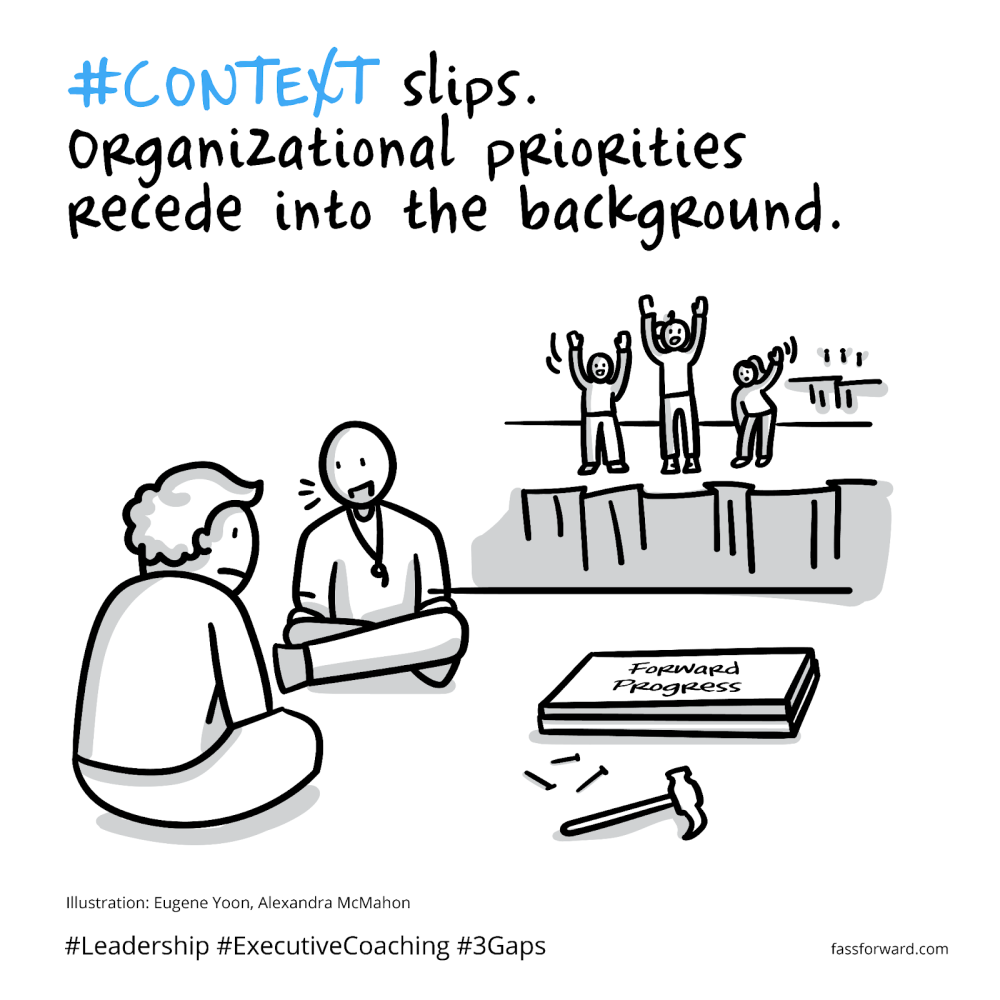
Too often, coaching starts with good intentions: a coach and a leader commit to months of work together. The leader invests deeply in reflection and self-awareness.
But that journey frequently becomes disconnected from the business itself.
Conversations turn inward.
Context slips. Strategy, culture, and organizational priorities recede into the background.
In some cases, the work drifts into a gray area that feels closer to therapy than leadership development.
That’s not a critique of therapy (my mom is a therapist), it’s simply not the purpose of executive coaching.
Leadership doesn’t happen in isolation, and neither should coaching.
At fassforward, coaching is treated as a team sport. It is grounded in the reality that leaders operate inside systems with peers, direct reports, boards, customers, and culture shaping every decision they make.
Coaching engagements are stronger when:
This approach doesn’t dilute the coaching relationship; it strengthens it. It keeps the work anchored in the business and ensures that growth is visible, relevant, and shared.
When coaching becomes overly individualized, leaders may feel supported, but the organization rarely feels the difference.
Another downside to the individualization of coaching is ROI.
If key stakeholders are not engaged in the process, how can ROI be accurately measured?
Ask 10 organizations how they measure the ROI of coaching, and you’ll likely get 10 different answers. Some will answer they don’t, while others approach it quantitatively, and still others use vague qualitative measures.
A big part of the problem lies in our reliance on the word goals.
Goals imply something finite, something to be achieved and checked off.
But leadership development rarely works that way.
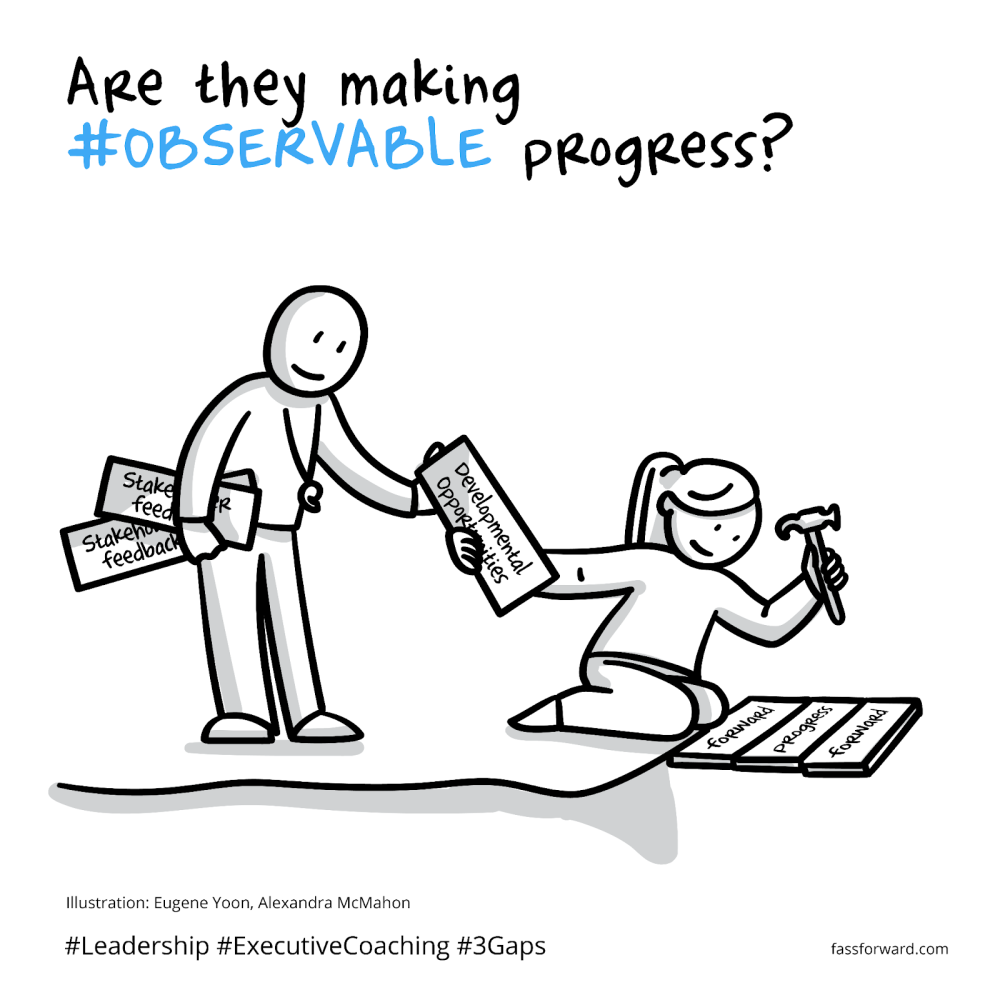
At fassforward, ROI is grounded in clearly defined developmental opportunities, not check-the-box goals. These opportunities are not problems to be solved once and forgotten. They are areas a leader will often work on, consciously and unconsciously, throughout their career.
The question isn’t whether they’ve “completed” something. The question is whether they’re making observable progress.
That’s why we believe ROI in Executive Coaching is best assessed by:
When peers, managers, and teams can say, yes, I see that shift, value becomes visible.
Not because a target was hit, but because impact changed.
Most executive coaching engagements are scheduled at regular intervals, typically every two or three weeks.
For busy leaders, those sessions often become familiar:
By the time the next session arrives, the moment that truly mattered has already passed.
But leadership doesn’t pause for a calendar invite.
Real leadership moments happen in real time: a tense exchange with a board member, a difficult conversation with a direct report, or a high-stakes strategy pivot.
We describe executive coaching at fassforward as a thinking partnership. If that partnership is based on scheduled calls, the opportunity for real time guidance and growth is challenged.
We think it is imperative that coaches are available when clients need them. If a leader has a challenging interaction with their CEO tomorrow, the best time to partner on it is before and after that moment, not 2 weeks later.
Coaching that only looks backward limits learning. Coaching that meets leaders in the moment changes behavior.

When executive coaching falls short, it’s rarely because of a lack of effort or care. More often, it’s because the structure doesn’t match the reality of leadership.
Coaching delivers far greater value when:
At fassforward, we view leadership as a practice, and coaching is a powerful way to accelerate that practice and drive improvement.
We also believe that no two coaching engagements are the same.
While we start with this foundational framework, co-creation on approach, additional data points to measure ROI (engagement surveys, retention rates, etc), and how to drive the best results are core to what we do.
Good coaching does not fix leaders. It helps them think more clearly, act more intentionally, and show up differently over time.
And when it is done well, the impact is not just felt by the leader. It is felt by everyone around them.

Open and explore more in ChatGPT
Imagine you were given $13,285,226 to invent something.
Better yet, you have sixty-two thousand customers ready to go. Evangelists. Early adopters.
So you take something good and make it better. You bolt on a USB charger. Add a waterproof Bluetooth speaker. Toss in an LED light. You take the idea of a Swiss Army Knife, smash it together with a cooler, and go nuts.
That was Ryan Grepper, the inventor of the Coolest Cooler.
In his words, “the COOLEST is a portable party disguised as a cooler, bringing blended drinks, music, and fun to any outdoor occasion.” Beyond the basics, his list of features was a grab-bag of tailgate dreams: A blender. A speaker. A phone charger. LED lights. A gear tie-down. Cutting board. Utensil storage. A bottle opener. All rolling on extra-wide tires.

It made a huge splash on Kickstarter and quickly became a huge failure.
Why do companies so often pursue innovation, and so often flunk?
I’ll bet innovation is somewhere in your list of priorities. Near the top of one of your strategy decks. Front and center at the next offsite. Snuggled between AI and customer obsession.
But while most large companies pin their hopes on innovation, only a handful of senior execs are satisfied with their performance, according to McKinsey.
So what’s going on?
While the well-worn Edison quote of “One percent inspiration and ninety-nine percent perspiration” is probably true, innovation doesn’t come from a single spark.
There is no Eureka! moment.
Innovation comes from running multiple engines concurrently. Each one pushing in a different direction, with a different mindset.
Innovative companies know this. These engines explain why innovative companies work—and where innovation fails.
Four engines power innovation:
Product out is about making the thing better.
Technology in borrows new tools, models, or technologies.
Customer in designs around customers' needs, not wants.
Future back bets on what’s next.
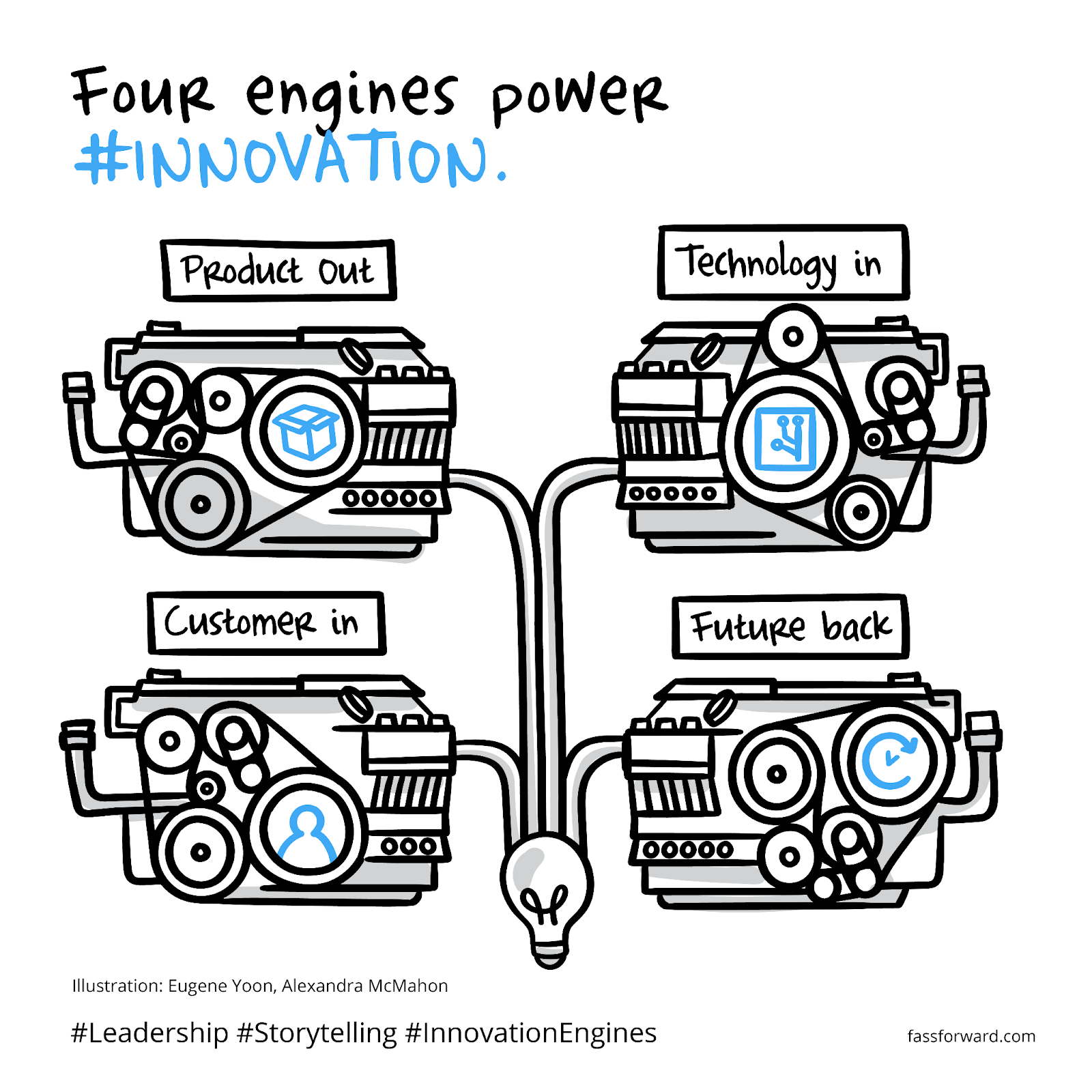
The out, in, and back are essential. They imply that each engine runs on a different track—a different vector. Each is a different point of view. Each requires a different mindset.
Product out is about engineering and iteration.
Technology in is about scanning and remixing.
Customer in requires empathy and observation.
Future back calls for vision and imagination.
Individuals, teams, and leaders are wired for one or two of those.
This is functional fixedness; if I have a hammer, everything is a nail. It’s the trap that makes us see a screwdriver and think it can only turn screws. We can’t imagine it as a lever, a wedge, or a weapon.

In organizations, this shows up as a disciplinary bias. Engineering teams run on Product out. Design teams and marketing live in Customer in. Technology naturally sees every problem as Technology in. Strategists and the senior team may bet on Future back.
To innovate, individuals and organizations have to be open to unlearning—ready to switch on, run, and align all of these engines.
Making the thing better.
This is the engine of iteration, refinement, and improvement. It’s feature-rich, tinkering, and fettling. It’s engineering-led, execution heavy, and often lives close to core operations.
This mindset comes with fixed phrases:
“Can we add a new feature?”
“How do we ship faster?”
“Let’s improve what we did last time.”
Real-world examples abound.
Think every iPhone generation from 1 to 15. Apple refines the camera, ups the display quality, and revs up the chip speed. Polish. Gain in increments. Each improvement drives share, sales, and margin, but the iPhone 15 isn’t fundamentally different from the first iPhone.
The same idea, kaizen’ed.
Most businesses live here.
Product out is the bread and butter of product development. It’s familiar. Comfortable. Budgeted. But Product out alone won’t give you breakthrough innovation. At best, it keeps you in the game. At worst, it’s a slow slide to irrelevance.
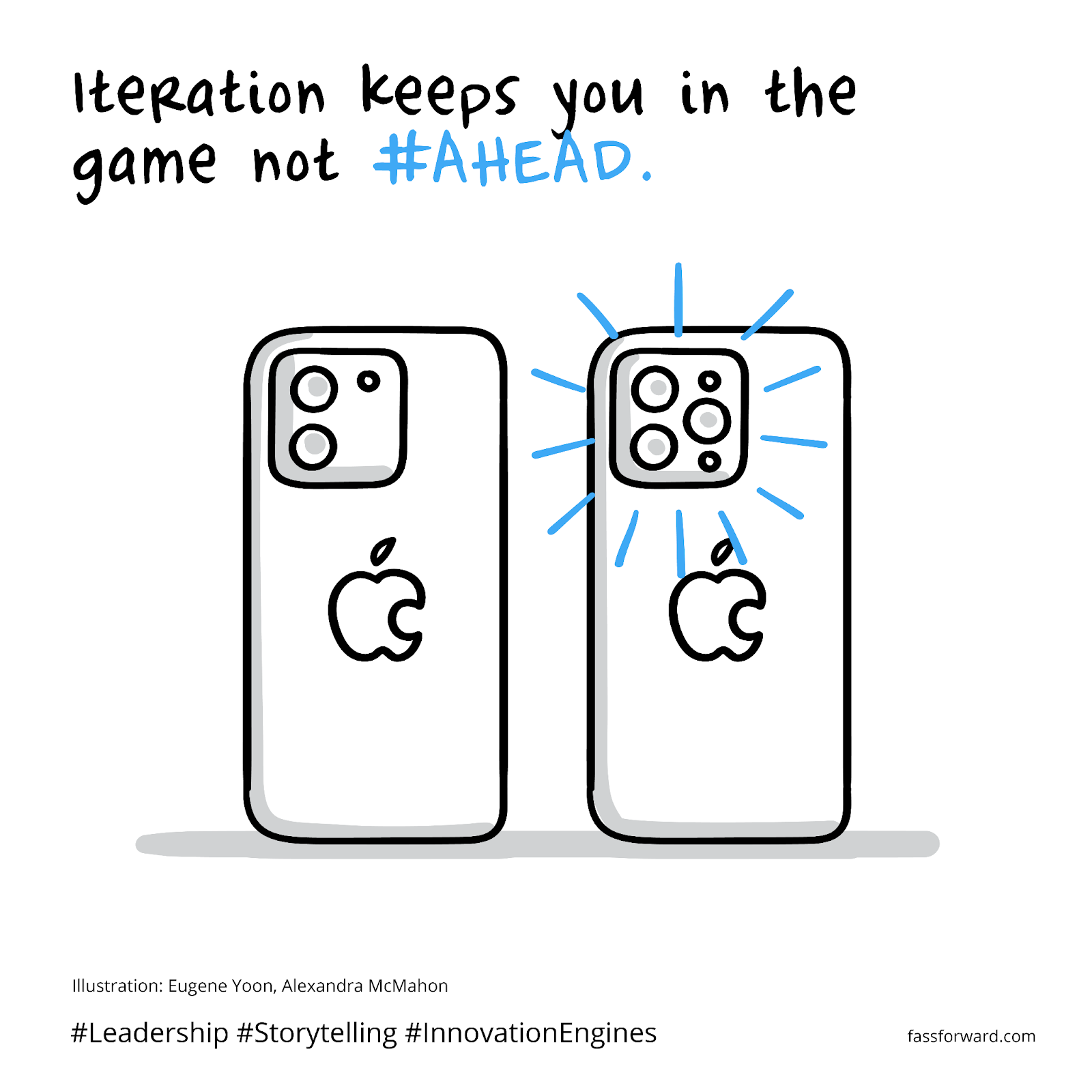
Overinvestment in product tweaks adds complexity, not value. It might be great engineering, but a poor market fit.
Borrowing new tools, models, or technologies.
This is the engine of adoption, adaptation, and remixing. It’s curiosity-driven. Outside-in. Often experimental.
It looks at what’s possible elsewhere—and asks, “What if we used it here?”
This mindset comes with fixed phrases:
“Can we plug this in?”
“What else could this do?”
“Who’s already solved a problem like this?”
Think touchscreen GPS. TomTom took map data, embedded systems, and touchscreen tech—none of it new—and combined it into a breakthrough consumer device. That’s invention as recombination.
The innovation wasn’t in the components—it was in the remix.
Technology in is scanning the horizon—and the competition—for something new to add to the mix. It’s the Estée Lauder chemist who goes to paint industry conferences to learn about advances in polymer science—and comes back ready to reinvent makeup.

It’s not just pure technology; it’s business model crossover; an Amazon team thinking about Airline loyalty programs, adding a pinch of Costco magic, and dreaming up Amazon Prime.
But Technology in alone is risky. Just because you can build it, doesn’t mean you should. Google Glass, anyone? Meta’s Smart Glasses? Segway?
That’s shiny object syndrome. Tool first thinking without a user point of view, a market that wants it, or an ecosystem ready for it.
Designing around needs, not wants.
Listening for the wish. This is the engine of insight, empathy, and behavior. It’s where design thinking sits. Understanding not just what customers say they want—but what they’re actually trying to do.
This stands product on its head.
Not, “here’s what we made.” But instead, “here’s what they need.”
This mindset comes with fixed phrases:
“Why are they doing it that way?”
“What’s the workaround here?”
“What’s the job to be done?”
Notion is a textbook example of innovation powered by the Customer in engine. They noticed people cobbling together ‘Frankenstacks’ of productivity tools. Notes in Evernote. Docs in Google. Tasks in Todoist. Then cobbling it together with Zapier and Slack. Notion built a product around how humans actually work, and innovated in the seams between software categories.

Airbnb, Venmo, and others understand that Customer in requires fieldwork: Ethnographic research. Usage data. Heat maps. Shadowing. User research before you build the product, not after, to validate all your hard work.
But Customer in alone isn’t enough.
Overindexing on the voice of the customer can lead to flops like New Coke and Heinz EZ Squirt ketchup. Both were short-lived consumer products where well-intentioned innovators only asked some of the right questions:
“Do you prefer your Coke a little sweeter?”
“Wouldn’t purple ketchup be fun?”
They got the answers they were looking for, not the behavior they were betting on.
What’s next? That’s a hard question to answer.
This is the engine of vision, foresight, and framing.
It’s strategy-driven. Narrative-heavy. Often uncomfortable. Scenario planning and long-bet thinking live here.
It starts with taking educated guesses at where the world is going—and asks, “How do we lead there?”
This mindset comes with its own fixed phrases:
“What’s the future we want to shape?”
“What will matter five years from now?”
“What’s the bold bet?”
Think of Space—building not just for the next launch, but to make life multiplanetary. Or Netflix—reading the bandwidth and pivoting to streaming while competitors clung to DVDs.

Future back is rarely obvious, except in hindsight. For every AWS and cloud, there is a Magic Leap and Second Life. It takes conviction, capital, and a tolerance for being early.
The engines run together and support each other.
One builds from the product.
One borrows from technology.
One listens to the customer.
One bets on the future.
Most teams run on one engine. Maybe two, if they’re lucky.
But the best innovations run on all four. They run in sync because the culture allows it, and the innovation story aligns with it.
OpenAI doesn’t just ship better models. That’s Product out.
It pulls in breakthroughs from transformer architectures and alignment research. That’s Technology in.
It shapes around human behavior—chat as the interface, natural language as the operating system. That’s Customer in.
And it’s betting big on what’s next. AGI. Safety. Multimodal reasoning. That’s Future back.
A culture that moves fast, tolerates ambiguity, and obsesses over mission.
And a story that frames the stakes—not just what they're building, but why it matters.
Culture makes it possible. Story makes it stick.
Open and explore more in ChatGPT!

Open and explore more in ChatGPT
Leadership isn’t about the title you hold. It’s about how you show up. How you think, act, and shape the world around you.
And this takes practice.
Leadership is a practice. A maturity you must build—and rebuild—over time. It doesn’t grow in a straight line. It loops.
Under pressure, we slide. At every level, we face new traps. But if we pay attention, if we’re curious, if we learn, we can move forward.
There are two loops.
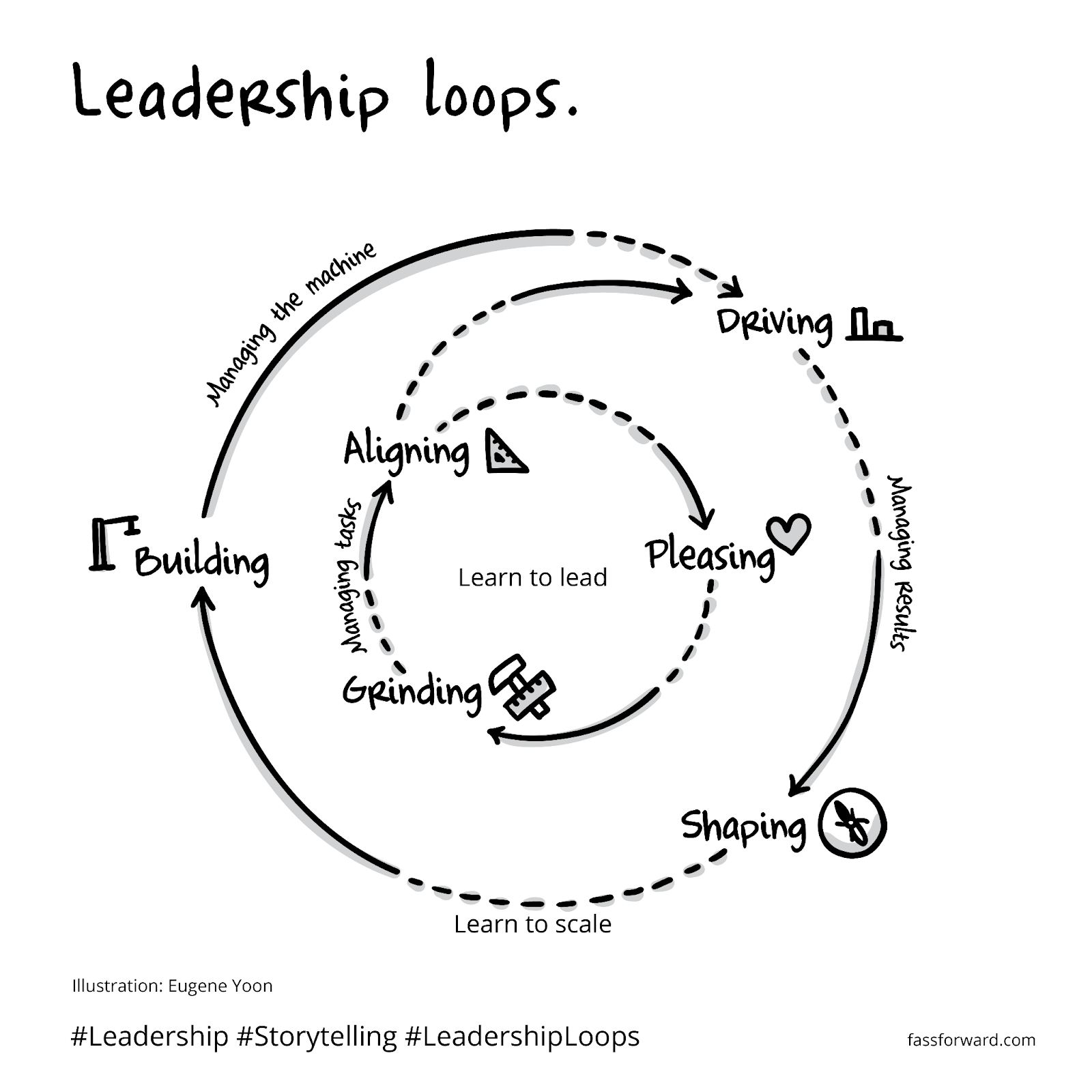
The inner loop is where you learn to lead. It’s focused inward and downward, on your team. Team 2.
The outer loop is where you learn to scale. It’s focused upward and across, on your peers and the organization. Team 1.
Learning to lead. This is where it starts: managing your team. Your energy is downward. You focus on how your team feels, how much they get done, and how their work lines up to a bigger goal.
The ultimate lesson is separation. You manage work, and you lead people.
You want to be liked. You avoid conflict. Harmony conquers candor.
This is normal. You focus more on Team 2—your direct reports—than Team 1, your peers. You want a positive culture. A good place to work. But sometimes, that means avoiding tension instead of facing it.
You smooth things over. You say yes too often.
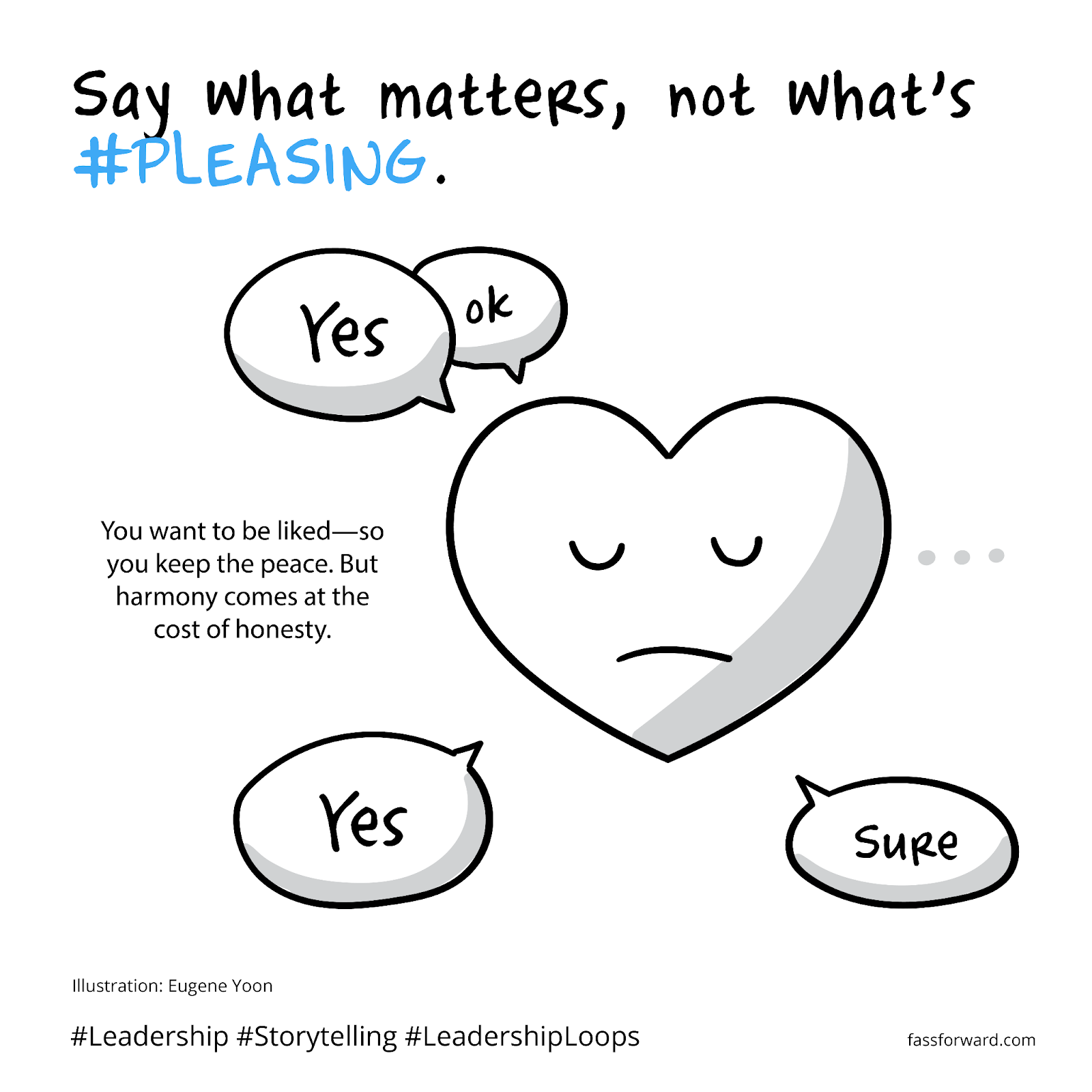
The trap: You avoid tough conversations. You mistake approval for progress.
The shift: Anchor to purpose, not popularity. Candor builds trust.
You get s**** done. Lists matter. Speed beats strategy.
You want to prove you can handle it—that you're reliable. That you and your team deliver. So you stay close to Team 2—clearing to-dos, jumping on problems, putting out fires. But sometimes, speed comes at the cost of direction. You don’t step back. You don’t set priorities. You don’t teach.
You mistake motion for momentum.
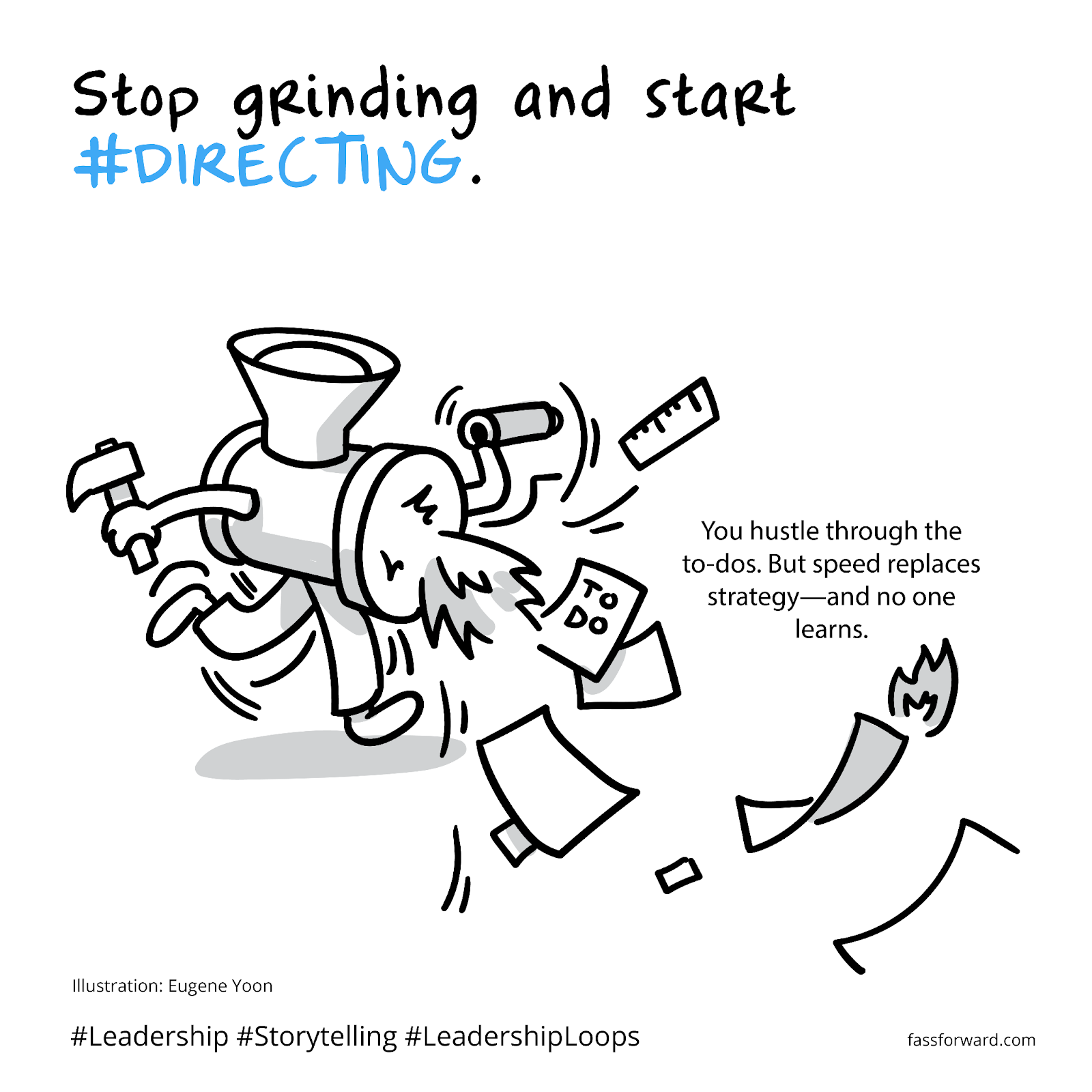
The trap: You become the fixer. You work harder instead of smarter.
The shift: Step back. Move from doing the work to directing the work. Teach.
You start pointing the way. Translating strategy. You prioritize.
You want your team to see the bigger picture—and their part in it. So you lift your head. You look sideways and up. You spend more time with Team 1. You connect dots. You explain the “why.” You introduce OKRs.
But the vision still lives in your head. The goals are still yours to chase.
You haven’t let go.
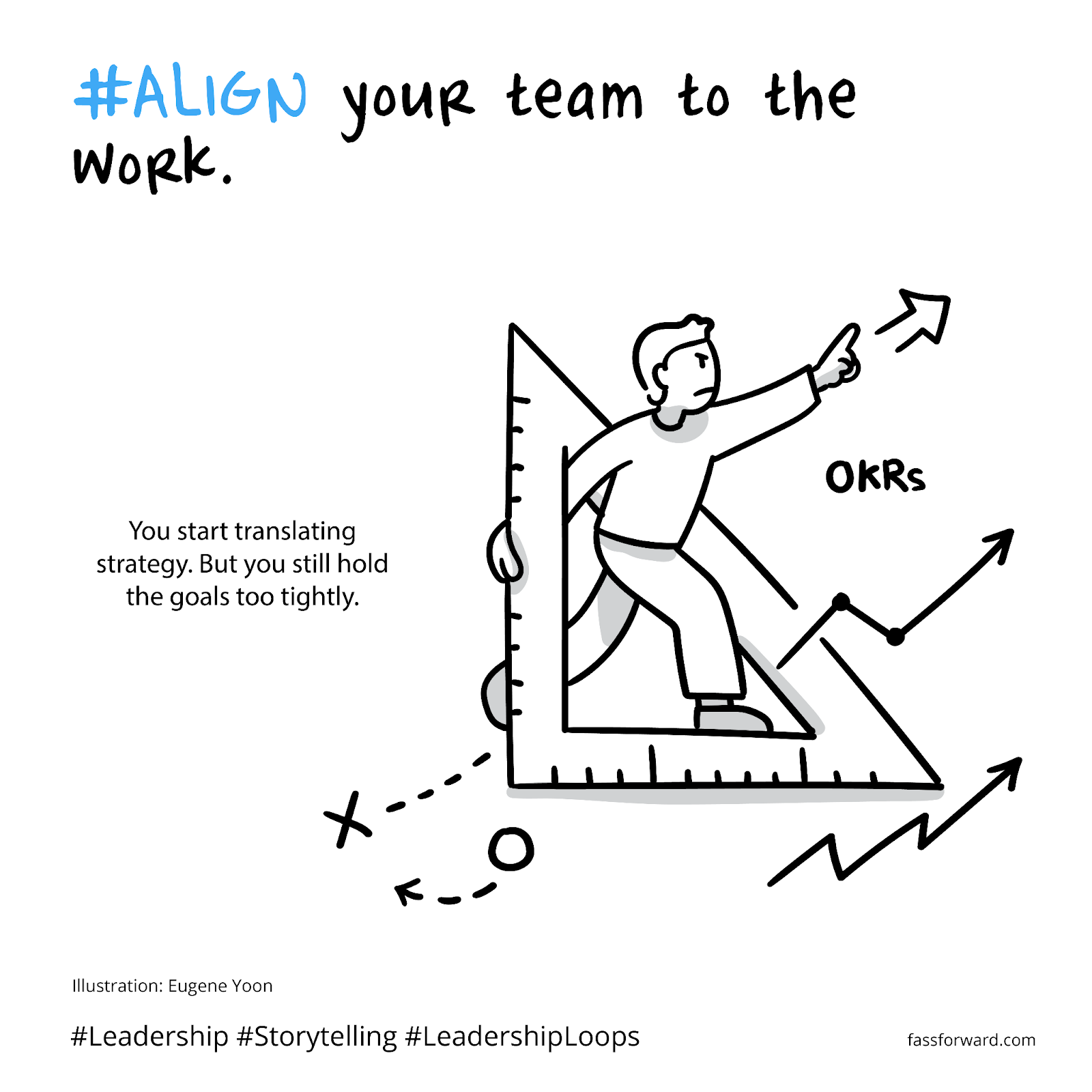
The trap: You over-own. You stay at the center of everything.
The shift: Let go. Delegate. Use OKRs to invite shared ownership.
This is expansive leadership. You have separated managing work from leading people. Now, you lead with your peers. Your energy is outward.
You connect dots. You set the tone. You push the work forward.
You shape culture. You translate strategy. You build systems.
The ultimate lesson is scale. You stop being the hero. You become the builder. You don’t just lead teams—you create the conditions for teams to lead themselves.
You raise the bar. You push for productivity. You prioritize results.
You’ve earned a seat at the table—and now, you want to deliver. You stay connected to Team 2, but your focus shifts to Team 1. You lead across. You set the pace. You measure what matters.
But performance runs through you. Every major decision. Every approval. Every next step.
You’re still cranking the engine.
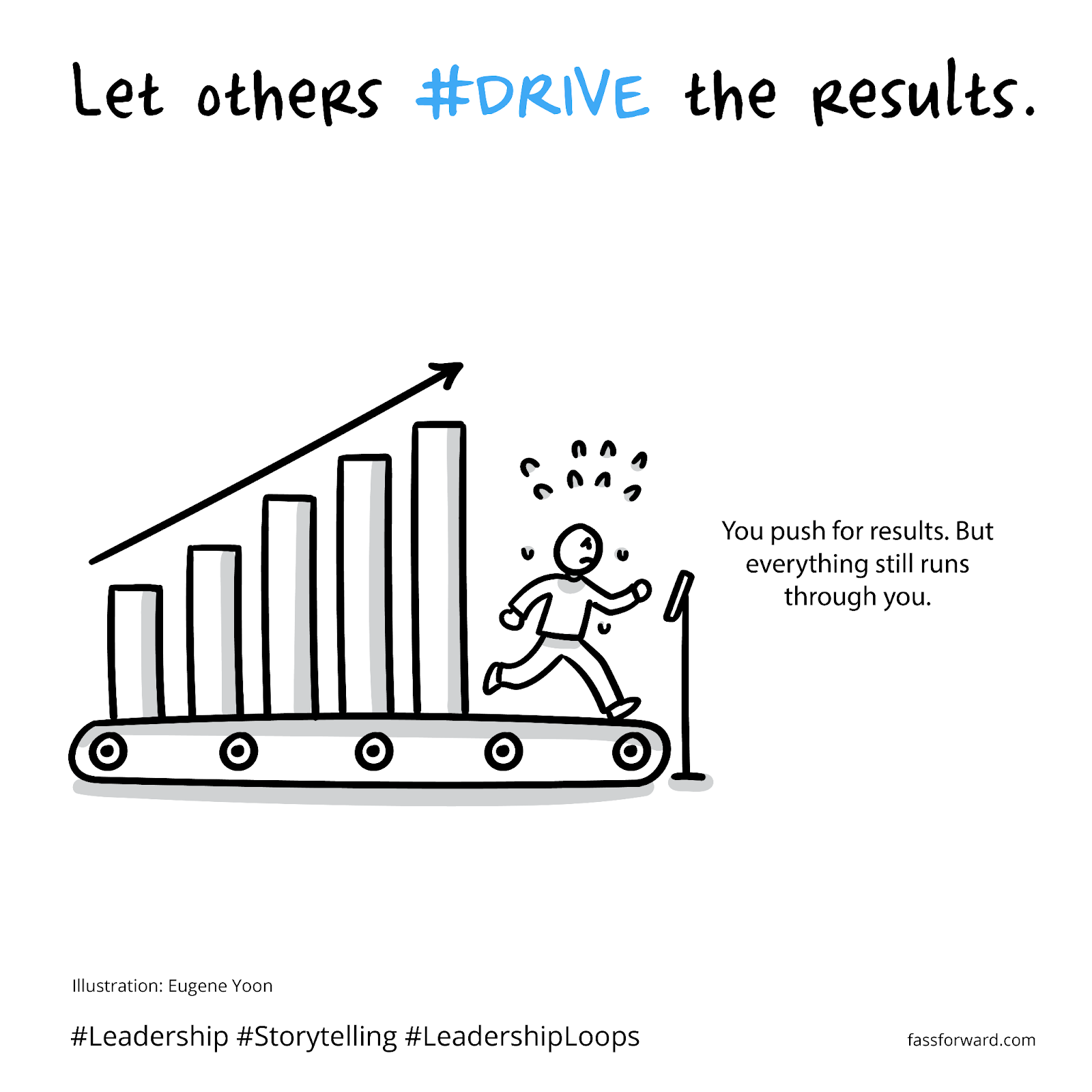
The trap: You become the bottleneck. Everything depends on you.
The shift: Step aside. Shift from force to flow. Embed ownership in the team.
You’re connecting dots. You’re setting the tone. You’re pushing the work forward.
You want clarity across the board. You want teams aligned and momentum building. So you shape direction. You clarify what matters. You drive shared priorities.
But ambition outpaces execution. The vision is clear—but delivery lags behind. You’re shaping the what and the why—but the how isn’t holding.
You haven’t built the system yet.
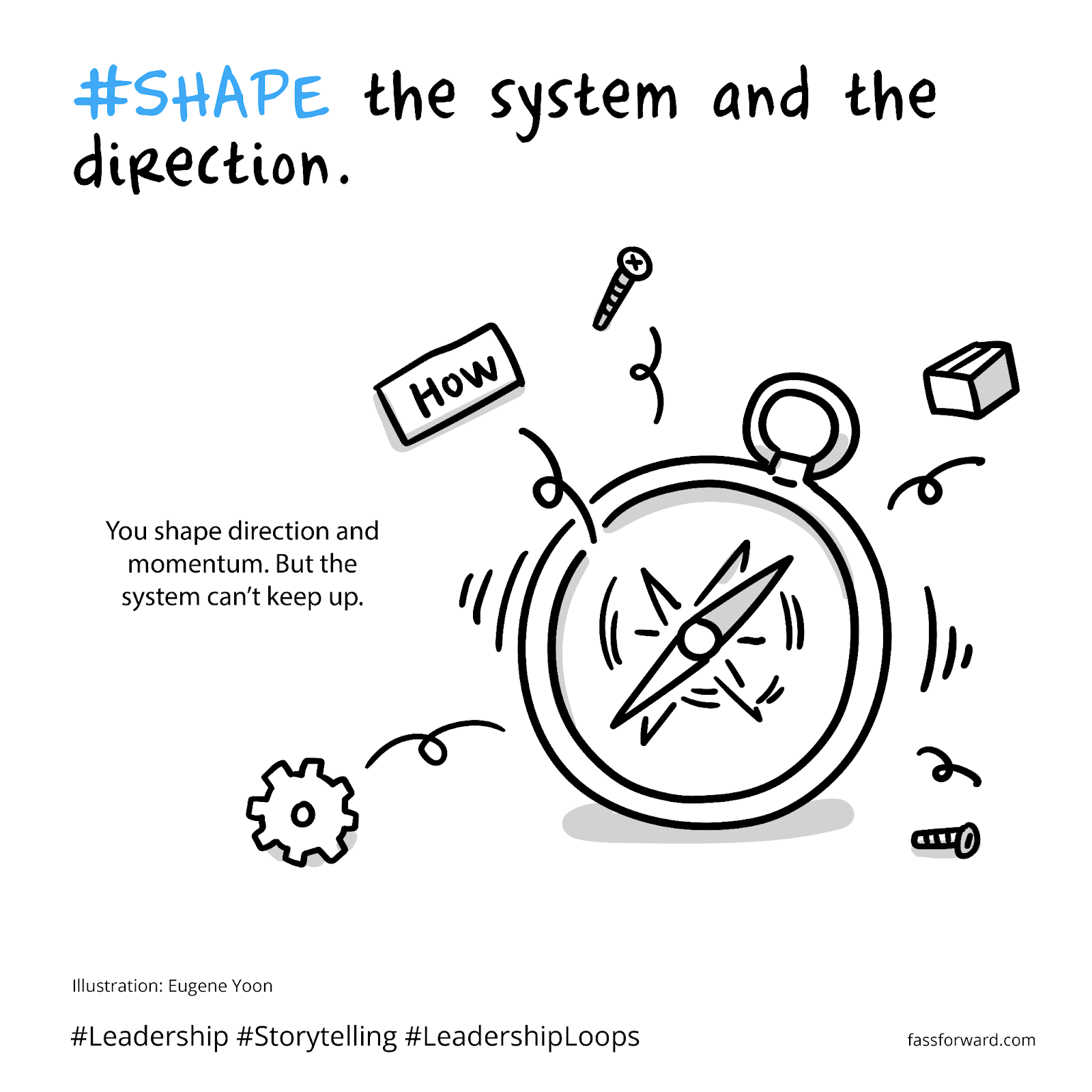
The trap: You lead ahead of the system. Strategy breaks from execution.
The shift: Slow down to scale up. Shape the system while you shape direction.
Zoom out. Zoom in. Think long-term and short-term. Build for scale.
You design systems. You shape culture. You grow other leaders. You build the machine.
You want results that last—beyond you, without you. So you simplify. You codify. You create patterns. You invest in rituals, feedback loops, and operating models.
The danger isn’t distance. It’s drift. The machine starts to slip. Systems ossify. Culture drifts. People slide back into old—bad—habits. And if you’re not careful, you do too.
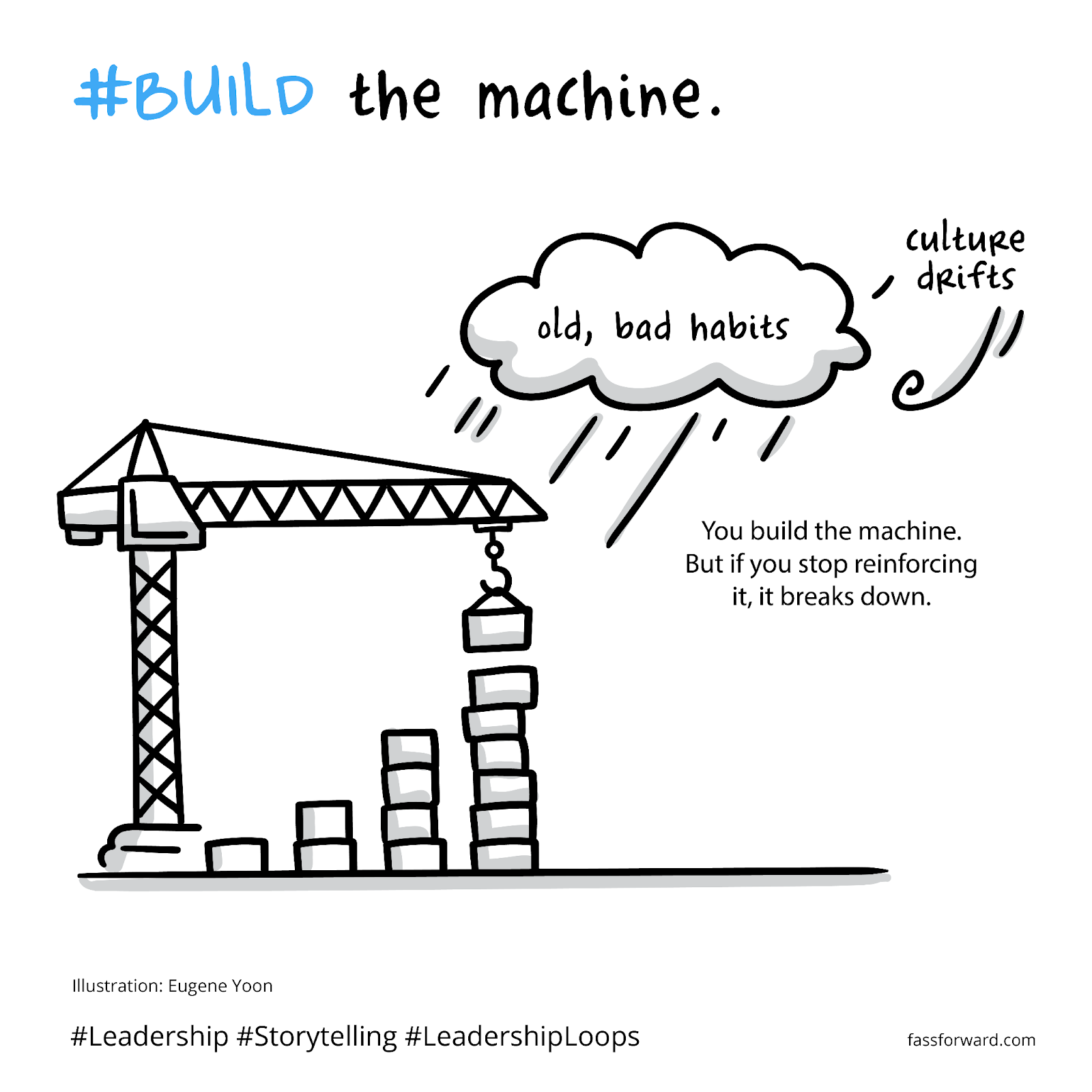
The trap: You let go too much. You slip back instead of scaling forward.
The shift: Stay close enough. Keep building. Reinforce what matters—until the system runs strong without you.
Leadership loops. You don’t finish them—you cycle through them.
You grow. You slip. You rebuild.
Ask yourself:
Where are you now?
Which loop are you in?
And what’s your next move?

We think a lot about teams.
How to lift them. How they drive performance in the business. How they shape culture. How they lead change, build with a product mindset, and translate strategy into action.
And it matters—McKinsey found that in critical roles, top performers don’t just outperform—they multiply. Up to 8x more productive than their peers.

So it’s worth asking, now and then, who’s on the team?
And more to the point—who shouldn’t be?
Meet the anti-team.
This roster of villains will do everything to slow you down. Left unchecked, they will put a wrench in the machine. They jam signals and erode trust. They’re a jargon-producing menace who make the simple complicated, and the straightforward complex.
You’ve met them before. You might be hiring them. You might even be creating them.
In descending order of dysfunction, they are:
#1. Mirrors.
#2. Puppets.
#3. Ghosts.
#4. Anchors.
#5. Spotlighters.
#6. Saboteurs.
You like them. Why wouldn’t you? They are a reflection of you. They think like you, act like you, echo your opinions. They nod along and rarely push back.
But that’s the problem. Mirrors don’t add—they reflect. And each reflection is a paler copy of the original. You get agreement without insight. Alignment without tension. Safe thinking. No friction.
Distortion disguised as agreement.

You’ll spot them by how quickly they agree, how often they reuse your words, and how rarely they bring something new to the table.
Mirrors are usually skilled and capable. Somewhere along the way, when status or certainty felt threatened, they traded originality for safety.
To shift them, invite dissent.
Demand candor. It doesn’t take confrontation—it takes a different task. Push them by giving them a safe way to push back. Put them in the role of a healthy skeptic. Have them lead a pre-mortem—a review of a project where they map out everything that could go wrong, before it does.
You want an anti-mirror: a challenger.
Someone who makes your ideas sharper, not softer.
They’re helpful. Reliable. They never push back. Never raise a hand. Never ask, “Why are we doing this?” They just nod, take notes, and wait for instructions. At first, that feels like a gift—someone who gets things done without hassle.
But puppets don’t think. They do. They’ve abdicated autonomy. You do the thinking—and the checking. You get execution without judgment. Transactions. Output without accountability.
The task gets done, but the point gets missed.

Watch what they don’t do. They ask, “Is this what you had in mind?” or wait for direction before making even small decisions. They’re always busy, but rarely out in front.
Puppets have skill. What they lack is will. At some point—possibly from you—they learned taking initiative meant risking blame. So they stopped.
To shift them, give them the problem, not the task. Ask for their take before sharing yours. Push them to make the first call—and most importantly, back them when they do.
You want an anti-puppet: an owner.
Someone who thinks before acting—and takes accountability for the outcome.
They were on the calendar. In the room. On the thread. But not really. They show up without showing up. There in body, but not in spirit. They’re silent in meetings. Absent in decisions. Invisible when work gets hard.
Ghosts don’t cause drama. They don’t stir conflict. They just... fade. You get presence without pull. Involvement without initiative. Login without lift.
They’re there, but not there.

You’ll notice them by their silence. Initials on a Zoom call. They don’t volunteer. They don’t raise blockers. And they don’t follow up. When the pressure’s on, they’re hard to find—and harder to count on.
Ghosts usually have the skill. They lack the will. That might look like laziness, but often it’s not. It’s overload. Or burnout. Or fear. When people feel their effort won’t matter—or won’t be safe—they pull back.
To move them, motivate them. Reconnect their work to what matters—to them. Ask what’s getting in their way. Make it safe to speak up, and make it count when they do.
You want an anti-ghost: a driver.
Someone who brings energy, not just attendance.
They might not mean to slow you down, but they do.
They question everything. Claim change fatigue. Rerun history with “why not...” and “what happened when.” They challenge every idea. Flag every risk. They ask for more data, more detail, and more time.
At first, it sounds like prudence. But anchors don’t let up. A decision made is a decision to reopen. Caution leeches away contribution. Feedback that sounds smart, but keeps you stuck.
Anchors resist change, hoping, “This too shall pass.”

You won’t hear a direct “no.” You’ll hear “let’s revisit,” “have we considered,” or “I’m not sure we’re ready.” Resistance, disguised as thoughtfulness.
Anchors often have both will and skill. They’re just not aligned with your agenda. They lack belief in the plan, in its pace, or the payoff. One foot in the past, unable to see the future.
To move them, engage them early. Invite them to shape the solution. Have them develop story 1 (the journey) and story 2 (the destination). Help them see themselves in the picture they’re resisting.
You want an anti-anchor: a catalyst.
Someone who helps you move—not holds you back.
They love the stage. The moment. The mic drop.
They lean in when the spotlight’s on, and step back when the real push begins. They show up big in meetings, pitch decks, and executive briefings. They speak in sound bites. Share wins, not worries.
When the work gets messy—when the team needs grit—they’re hard to find. Persistence isn’t their strong suit.
Spotlighters chase recognition, not results.

See how fast they jump in, and how fast they fade. They lead the kick-off, but miss the check-in, already chasing the next big thing. They celebrate outcomes they didn’t help drive. First to post, last to push.
Spotlighters have skill and will, but it’s misdirected. They invest where the recognition is, not where the real work happens.
Sometimes it’s ambition. Sometimes insecurity. Often, it’s a learned behavior in environments that reward heroes, not hard work.
To move them, shift what you celebrate. Glorify effort, contribution, and perseverance—the small steps, not just the big gains. Shine a light on follow-through and follow-up. Track ownership, not airtime.
You want an anti-spotlighter: a steward.
Someone who stays with it, not just when the lights are on.
They don’t just block the work. They break the machine.
Saboteurs were French factory workers who tossed their wooden shoes—sabots—into machines to grind them to a halt. Now they’re on your team. Whispering doubt. Stirring resentment. Building friction.
Sometimes it's subtle: passive resistance, loaded questions, side comments, and backchannels.
They undermine trust and corrode culture.

You’ll feel it before you see it. People pull back. Meetings get tense. Pocket vetoes multiply.
Saboteurs often have both will and skill. They lack alignment. They’re smart, experienced, and working against you. Sometimes it’s political. Sometimes it’s personal. Often, it’s a response to feeling sidelined, unrecognized, or a loss of power.
To move them, surface the behavior. Name it—clearly and calmly. Set clear expectations and guardrails. Don’t feed into the behavior by tiptoeing around it. And if nothing changes, you may need to make a tough call.
You want an anti-saboteur: a force multiplier.
Someone who builds trust, fuels momentum, and makes everyone around them better.
The best teams don’t just happen.
They’re shaped by who you bet on, who you build up, and who you stop carrying

Everyone’s chasing the next big thing. A new app. A better mousetrap. A new AI something-a-jig.
But novelty alone isn’t the answer.
Innovation is not new.
For a product-leading company, it’s not a new product—it’s a better way of delivering value that customers care about.
For a customer-intimate company, it’s not a new feature—it’s a deeper relationship that creates opportunity.
For an operationally excellent company, it’s not a new process—it’s a better outcome at scale.
The pressure to innovate never stops.
Customers expect it. Competitors chase it. Change demands it.
But not all that is new moves the needle.
Innovation, then, follows a simple formula:
Without Novelty, innovation is ho-hum. Lacking Value, you have a gimmick. Deduct Impact, and you have a missed opportunity.
Novelty is a new product, feature, or process. Value is what customers care about: the resolution to their problem, a job to be done. Impact changes a behavior at scale. The product gives its end user a better version of themselves.

Value comes from making it—the job to be done—cheaper, faster, easier, or smarter.
Impact is the differential. The difference between the old way and the new way. The difference between the old me, and the new version of me.
Look at any innovation—chopping and bagging a lettuce (Fresh Express), putting a million songs in your pocket (Spotify), turning taxis into apps (Uber), from renting to streaming (Netflix), going to the store to pressing “Buy now” (Amazon).
You see patterns.
Those patterns—those truths—can guide your innovation journey, whether you are rethinking a product, reinventing a process, or redesigning a service. They are:
#1. Innovation is a remix.
#2. Innovation lives in the seams.
#3. Innovation loops and learns.
#4. Innovation dies without execution.
#5. Innovation requires unlearning.
#6. Innovation lives in a system.
When Steve Jobs launched the iPhone in 2007. He told a story of three technologies fused together: A wide-screen iPod with touch controls, a revolutionary mobile phone, and a breakthrough internet communications device. Three devices, fused together.
Jobs’ genius was to remix. The Mac took from his college fascination with calligraphy. Pixar blended storytelling and computer graphics to reinvent animation. NeXT and later the iMac reimagined software and hardware design—merging beauty and function.

Innovation doesn’t come from nowhere.
It’s the recombination of existing ideas, tech, or models—reframed in a new context. Great innovators borrow, blend, and bend what already exists to unlock new value.
Think DJ, not diva.
Write → Save → Attach → Email → Edit → Repeat.
Throw in a couple of blue screens, and you have collaboration circa 2010. Teamwork by inbox. Collaboration by version control.
Then Google changed the game. They bought Writely, an online text editor. And Docverse, which lets people co-edit traditional office files.
The seam: collaboration. The result: a living document.
Write → Edit → [Collaborate]
One doc. One team. One shared space.

Innovation crosses boundaries—product, process, service, business model, experience.
Real innovation rarely stays in its lane. And when it hops categories, it changes the game.
If it doesn’t challenge a boundary, it’s just an upgrade.
Humans like straight lines and good stories.
Here’s one consultants tell: NASA spent millions of dollars developing a pen to write in space, while the Russians used a pencil.
Codswallop.
Pencils break. Tips float. Graphite dust is flammable and conductive—not ideal in a pressurized capsule filled with electronics and oxygen.
The real story: Paul Fisher, a private inventor, spent his own money to develop the Fisher Space Pen, filled with a pressurized ink cartridge that could write upside down, underwater, and in zero gravity.
NASA tested it, then bought it. So did the Russians.
Both agencies still use it today.
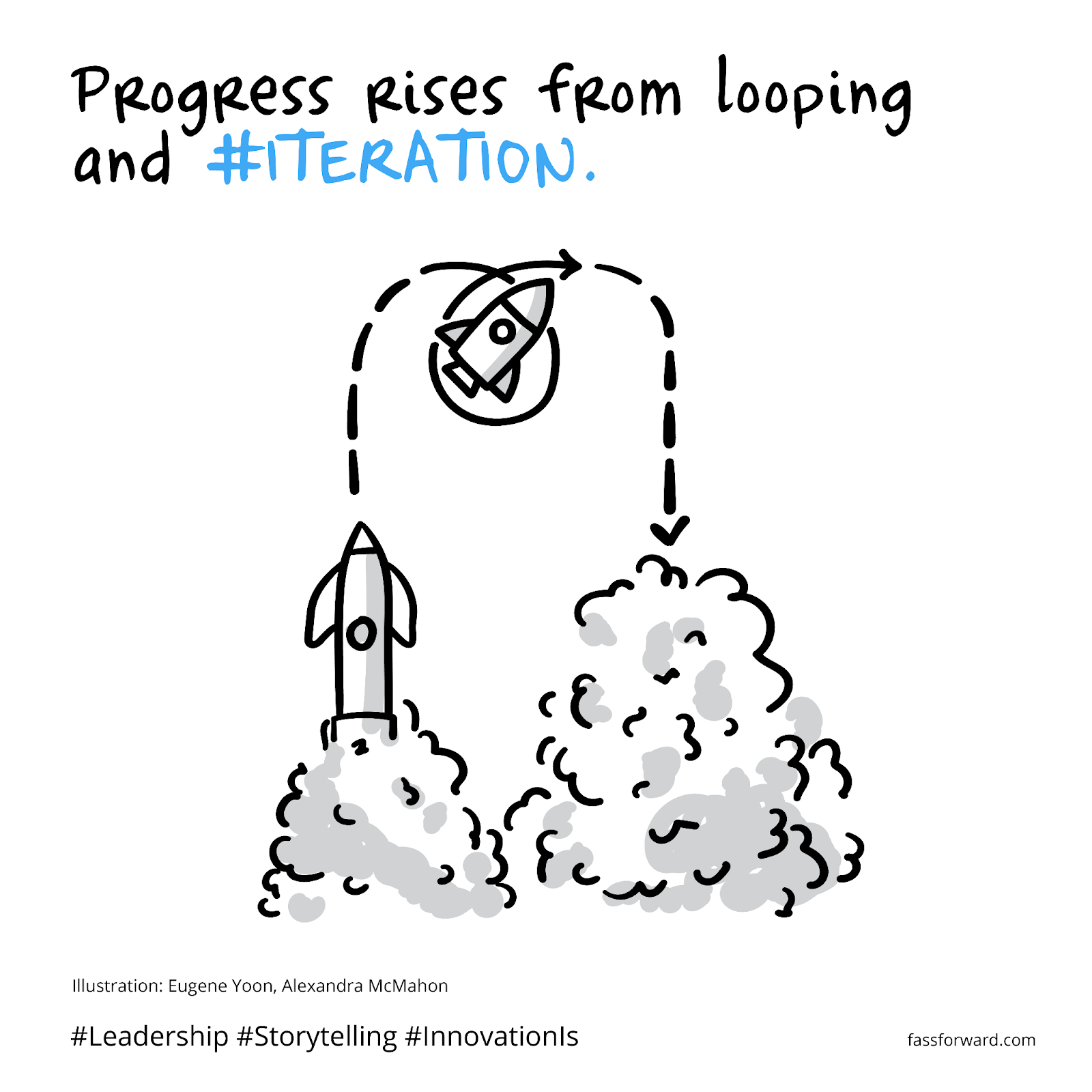
Successful innovation moves through stages:
Idea → Concept → Prototype → Development → Production → Adoption.
Each stage is a gate. And at every gate, it can fail—and teach you something.
Innovation isn’t smooth. It’s not a straight line. It’s a loop—of learning, adjusting, and adapting. The best innovators constantly circle back. They iterate. They test again.
And get smarter with every pass.
Ideas are ten a penny. They’re important, just not that important.
Execution matters. Idea to sketch. PowerPoint to prototype. Prototype to production. Production to payoff.
Pinocchio wasn’t real because he was carved from wood.
He became real through struggle: every setback taught him something. That’s the path to execution. The devil is in the details.
James Dyson had an idea after his vacuum clogged. He worked the problem. 5,127 prototypes and five years later, he launched a product that changed the industry.
Ideas are cheap—especially now, with AI. What is not? The persistence that brings an idea to life. Shipping is hard. Testing, building, scaling, and surviving resistance—is the sweaty part.

It’s not the spark. It’s the follow-through.
Everything is obvious once you know the answer.
But if pre-cut, bagged lettuce is so obvious, why didn’t anyone do it sooner?
Why did it take Amazon so long to invent 1-click ordering?
Technically, they could have launched it in 1996. They had user accounts. They stored credit card and shipping info. They ran their own checkout pipeline.
So why wait three years?
Because the dominant mental model was retail brain—copying the physical store into a digital world. Shopping carts, multi-step checkouts, and a final confirmation.
The logic of bricks and mortar, ported to pixels.
Three years isn’t a long time for the obvious to emerge. Try 112 years.
Martin Eberhard drove his first roadster in 2006, three years after founding Tesla. That’s a blink compared to the Electrobat, the first commercially viable working electric car, in 1894
Why did it take so long?
Because for 100 years, we believed gasoline was the future. That range, speed, and power only came from combustion. Infrastructure followed belief. And belief is hard to unlearn.

The biggest barrier to innovation isn’t imagination—it’s expertise.
The logic that made you successful is blocking what’s next. To invent, you must first unlearn.
You have to let go of what you know to see what could be.
No idea wins in a vacuum.
In The Wide Lens, Ron Adner shows why some of the best innovations fall flat. Not for lack of imagination—but because the system wasn’t ready.
Adner tells the story of Philips’ CD-i—a 1990s multimedia platform that could play music, video, games, and more. A product ahead of its time.
But it lacked content. Retailers didn’t know how to sell it. Consumers didn’t know what it was for. It flopped. Not because of the product, but because of the system.
When Apple launched the iPod, it launched into an ecosystem. Music rights, handled by iTunes. USB 2.0 for faster syncing. An army of early adopters using Napster, Kazaa, and LimeWire.
The timing was right, the partners were ready, and the customers were primed.

Product-market fit means you are solving a problem people care about. Ecosystem fit means the world is ready for your answer.
Customers, partners, timing, and readiness all matter. Ecosystem fit is as critical as product fit.
A brilliant idea at the wrong time is still a failure.

"Al won't take your job, it's somebody using Al that will take your job."
I believe this comment by Economist Richard Baldwin at the 2023 World Economic Forum's Growth Summit sums it up best. Al is already transforming leadership coaching. According to a May 2024 data from Similarweb, ChatGPT attracts 260.2 million visitors each month. If you are not using Al yet, you can feel confident that your competitors are.
A Powerful Partner
Al is a game changer for the coaching industry.
One of the biggest advantages Al brings is a more rapid, data-driven approach to coaching.
Traditionally, coaching has relied on subjective feedback from peers or annual reviews. With Al, our coaches can synthesize vast amounts of data ranging from 360 feedback to results from our proprietary tools to their coaching calls in a fraction of the time they used to and with more accuracy. This also allows our coaches, who are on call for our clients, to... [Read more here]

You: I’m proud of the team. They’ve really stepped up.
Your boss: Yeah? How so?
You: They’re owning it. Helping each other. Calling out issues. Getting stuff done. It’s starting to feel like a real team.
(pause)
Your boss: Which team are you talking about?
You probably didn’t even hesitate before answering. And that’s the problem.
...
You may not realize it, but you are on at least two teams.
The team you lead—and the team you lead with.

Most of us don’t think that way. We default to calling the team we lead “my team.” We refer to the other one—our peer group—as “the senior team” or “the leadership team.”
Which, if we’re honest, we think of as our boss’s team.
Wrong.
Patrick Lencioni makes this clear in The Advantage.
“Leaders are not there simply to represent the departments that they lead and manage but rather to solve problems that stand in the way of achieving success for the whole organization.”
In most cases, the opposite is true.
“When members of a leadership team feel a stronger sense of commitment and loyalty to the team they lead than the one they’re a member of, then the team they’re a member of becomes like the U.S. Congress or the United Nations: it’s just a place where people come together to lobby for their constituents.”
It’s a simple but powerful idea.
Team 2 is the team you lead. Team 1 is the team you lead with.
Embracing that mindset is a cure.
A cure for siloed thinking, turf wars, misaligned priorities, slow decision making, bureaucracy, and swirl.
Siloed thinking is “my part works.”
It’s staying in your lane, hoarding information, and building up coordination debt—the hidden cost of not working across teams.
Turf wars are “that’s mine.”
When leaders defend their patch instead of solving for the whole. The political intrigue. The meeting after the meeting. Passive-aggressive infighting.
Misaligned priorities: “We’re not on the same page.”
Every team is pulling in a slightly different direction. One’s sprinting. One’s stalled. One is solving the wrong problem.
Slow decision making: “Let’s circle back.”
No one owns the call—or worse, everyone’s waiting on each other. More data is requested. Problems drift. Cans are kicked.
Bureaucracy or “check in with me first”
Process becomes a proxy for trust. Hierarchy matters. Rules trump relationships. Forms and formality prevails.
Swirl: “Haven’t we had this conversation before?”
Rework and rehashing. Stuff moves at a glacial pace. Ducks are lined up, the order is questioned, and the ducks line up again.

That shift—from leading your team to leading with a first team mindset—changes everything.
It pulls you out of silos and shortcuts toward enterprise success.
These six rules make it real.
#1. Lead with one face.
#2. Say the hard thing.
#3. Hold each other to the standard.
#4. Own the outcomes.
#5. Speak as one.
#6. Make it make sense.
Here’s what each rule looks like in the wild.
It’s easy to act differently between Team 1 and Team 2.
The power dynamics are different. You’re not the most senior person in the room anymore. The stakes are higher. The audience is tougher. Someone has a bigger box than you on the org chart.
That creates pressure: to posture, to protect, to play it safe.
But here’s the thing: consistency builds trust.
People notice the difference when you’re open with your team but guarded with your peers. When you micromanage one way but defer in another. When you show empathy down but act defensively across.
Don’t wear two faces.
Authenticity isn’t a performance; it's a pattern. And people are watching.

You avoid conflict because you’re nice.
You’ve learned the hard way. Say the wrong thing: to a peer, to a boss, and it bites you. So you hedge. You soften. You caveat. You wait for someone else to go first.
But here’s the thing: Silence doesn’t keep the peace, it keeps the problem.
Team 1 isn’t about being nice; it’s about being clear. Candid. It’s what Lencioni calls “mining for conflict.” Actively looking for the tough conversations that most teams bury. Because when problems stay hidden, so does progress.
That means naming the issue. Surfacing the tension. Challenging the thinking—early, openly, and in the room.
You don’t have to be rude, but you have to be real. Deliver feedback in the moment, not after the fact.
Team 1 embraces candor during the conversation.

This is a key component of operational excellence—setting standards, then raising them.
It’s hard to set a standard. Harder still to live up to it. Hardest of all? Calling it out when someone doesn’t.
But that’s the job.
Accountability isn’t just vertical.
If someone’s off track, say it.
If something’s slipping, step in.
Feedback—sharing concerns as unmet needs, and asking team members to step up—should be the norm on Team 1 and Team 2.
Holding each other accountable to agree on standards, especially when no-one else does. Especially when it’s uncomfortable.
Especially when no one else is saying it.

True team 1 thinking is about creating outcomes.
Not just for your function—but for the business. Team 1 leaders walk out aligned—even if they walk in disagreeing.
It’s stepping outside the hierarchy. Sharing in enterprise success, not creating silos and protecting turf. This gets easier when outcomes are discussed, agreed, and shared.
Team 1 means shared goals. Shared accountability. One scoreboard. One outcome.
You can still advocate for your team. You should. But you also own the tradeoffs. The compromises. The messy middle.

This is where many leaders slip. They nod in the room—then shift the story afterward.
“It wasn’t my call.”
“They decided.”
“We’ll see how it plays out.”
That’s managerial ventriloquism. You become the mouthpiece for a decision you don’t own. And your Team 2 hears that.
Team 1 leaders speak with one voice.
They walk out aligned. Not to carry on the conversation in the corridor, but to carry the message with clarity and conviction.
To own the decision.

Decisions made in Team 1 don’t matter if they don’t land in Team 2.
It’s easy to repeat the “what.” Much harder to explain the “why.”
But that’s the job—translation, not transmission.
Your team doesn’t need cryptic slides or a word-for-word recap. They need message discipline. Clarity. Context. Simplicity. Better yet—radical simplicity.
If it’s not clear enough to remember, it’s not clear enough to act on.
If the message changes by the time it hits the front line, it’s not a cascade—it’s a game of telephone.
Making it make sense isn't just about what you—or they—say. It’s what they remember. What they repeat. What they act on.

So: which team are you showing up for?

Unlearning isn’t forgetting; it’s clearing old habits to make room for smarter ones.
Fifty years ago, Alvin Toffler made an unnerving prediction. “The illiterate of the 21st century will not be those who cannot read and write, but those who cannot learn, unlearn, and relearn.”
Add AI to the equation. A seismic upheaval in how we work is changing how we think. Call it (Toffler) x 10.
Calculators dulled our mental math. GPS eroded our sense of direction. Spellcheck weakened our spelling.
Now, AI summarizes documents we don’t want to read, writes emails we don’t want to write, and finds answers we don’t want to search for.
Outsourcing our thinking dulls the mind. If we let it.
As AI takes up the routine, it leaves us standing with Toffler’s challenge: learning, unlearning, and relearning.
Or at least, we were. That’s the story I am sticking to.
In 1968, NASA commissioned a study to find highly creative engineers and scientists. Researchers George Land and Beth Jarman tested for what they called divergent thinking—the ability to generate multiple, novel solutions to a problem.
When NASA engineers took the test, only a small fraction hit the “creative genius” level. But when 5-year-olds took it, 98% did. According to Land, “non-creative behavior is learned.”
We don’t lack creativity. We’ve layered over it with habits that get in the way.
To reclaim our creative genius, we have to unlearn these habits.
And before we do that, we must burst through some barriers:
Functional fixedness, the blinkers that prevent us seeing possibilities. If we have a hammer, we see nails everywhere. It’s the false confidence that we already know best.
Stuck thinking where how we react to problems follows a familiar groove. It’s not just the comfort with the familiar; it's discomfort with new ways of thinking.
We cling to opinion over evidence. Data doesn’t move people if it flies in the face of deeply held beliefs. We stick with old, familiar ideas, even when the facts should move us on.
Emotional attachment looms large. Our past successes and pride shapes who we are. Which makes letting go hard.
A culture of fear. Where it isn’t safe to make mistakes, or ask dumb questions, or it’s frowned upon to pick at sacred cows. Where failure is punished (or even perceived as such), people stay frozen.
Blind spots abound. You may not be familiar with the Johari Window, but you live in one. There are things others see (the known unknowns) and that no one sees (the unknown unknowns). The trouble is, blind spots stay blind, unless we’re willing to listen, look harder, and rethink.
Unlearning is hard because our brains are built to repeat, not rethink. We have to break habits and overcome defaults: the pull of the familiar, the comfort of being right, and the instinct to protect what worked before.
Unlearning takes six moves:
#1. Spot what’s stuck.
#2. Loosen your grip.
#3. Dig before you discard.
#4. Shift the payoff.
#5. Replace the habit.
#6. Unlearn together.
You can’t fix what you can’t see.
Once we’ve built habits—automated behaviors and ways of thinking—we stop questioning them. They dissolve into the background.
Look for friction that’s no longer noticed: clunky processes, functional silos, outdated KPIs, and reports no-one reads any more. Pay attention to new team members and outsiders with different perspectives.

Ask yourself:
What am I doing because it used to work? And,
What assumptions no longer hold true?
At AWS, teams use “Working Backwards” documents—starting with the ideal customer outcome and tracing backward to find friction. If it doesn’t serve the user, it’s up for debate.
At Spotify, retrospectives are a habit—not just in product teams, but across functions. Spotting what’s stuck is built into how they work.
At Stripe, internal postmortems are used to surface friction—without blame. It’s a structured way to find what’s broken before it slows work again.
You can start unlearning now.
Ask the team, “What are we doing that no longer makes sense?”
Write it down. Look for patterns, then act on them.
Holding on is what’s holding you back.
It’s the monkey jar principle. A monkey reaches into a jar to grab a piece of fruit... but can’t pull its hand out while still holding it. The monkey stays trapped, not because it’s tied down—but because it won’t let go.
We do the same thing. We hold onto old routines because they once brought success and status. We protect them. Defend them. Wrap our identity in them. Even when they no longer serve us.
Look for signs of grip: resistance to change that’s a pit in your stomach. Defensiveness that tightens your jaw. Perfectionism covering up anxiety.

Ask yourself:
What am I afraid to let go of—and why?
What would I stop doing if I didn’t have to protect [this]?
At AWS, writing a future press release forces teams to let go of today’s assumptions and imagine the product from a world that doesn’t exist yet. It creates a safe distance from the present and space to let go.
Spotify uses lightweight launch checklists that emphasize learning over perfection. Teams are encouraged to ship early, with known gaps, as long as there's a feedback loop in place. The focus is on momentum, not getting it perfect the first time.
At Stripe, new hires are invited to question—and even rewrite—their onboarding docs, including those written by their managers. It sends a clear message: what worked before isn’t sacred. Letting go is part of learning.
Loosen your grip.
Ask your team: “What are we holding onto that helped us then, but hurts us now?”
Say it out loud and let go together.
Unlearning isn’t a conflagration. It’s an excavation.
We don’t need to burn everything down.
Some ways of working served us well. Some still do. The danger is in assuming all legacy is dead weight or that every new idea is better by default.
Unlearning means sorting the gold from the gravel. Finding what needs to change and what can stay the same.
Clean-sheetism is great. For brainstorming. But it can lead to big swings, total resets, and a tendency to kill before we understand. At some point, it is met with resistance, and teams will throw out the old playbook only to recreate it under a new name.

Ask yourself:
Which part of this actually worked?
What ‘soft systems’ (relationships, rituals, norms) should stay?
What would we keep if we were starting from scratch?
At AWS, before building anything new, teams start with a press release and FAQ—then dig into existing workflows, metrics, and habits that might conflict with that future state. It’s not about throwing everything out—it’s about aligning what already exists with what customers actually need.
Spotify teams run “Start / Stop / Keep” sessions in retrospectives—not everything old gets tossed. Some rituals evolve. Some are revived, if they still serve the team.
Stripe teams regularly audit internal tools and processes before replacing them. Engineers are expected to ask: “Is the pain here in the tool—or how we’re using it?” Often, it’s not a rebuild that’s needed, just a rethink.
Find what matters and toss the rest.
Before you change something, stop and ask: “What are we trying to fix — and do we understand it well enough to move on?”
Don’t discard. Dig.
Unlearning is unnatural. It feels like failure.
Letting go of what once worked can feel like admitting you were wrong. Setting aside a routine, a system, a process—even a mindset—feels like a betrayal of what made you successful in the first place.
That's why we cling to the past.
To change the context, change the reward—from old to new:

These signals are sticky. They tell people what’s really valued—and what’s not.

Ask yourself:
What are we actually rewarding?
What behavior gets recognition, but might be holding us back?
What would we reward in a company that celebrates speed, learning, and impact?
Amazon rewards teams for spotting flawed assumptions early, not just for what ships. Failure isn’t punished; false certainty is.
At Spotify, speed of learning matters more than polish. Leaders praise fast feedback loops and smart pivots—momentum beats mastery.
At Stripe, senior leaders make a point of sharing what they’ve changed their minds about. That signals unlearning as strength, not loss.
Reward differently.
Shine a light on someone who stopped doing something that no longer worked and made space for something better.
Change what you celebrate.
Stopping isn’t enough. You have to swap it for something better.
Unlearning leaves a gap. A vacuum. A pause between what you used to do and what you’ll do next.
If you don’t fill that gap, the old habit creeps back in. That’s how defaults survive—not because they’re strong, but because they’re familiar.
Old habits fade when they’re overwritten, not just erased. You introduce a new tool, but no new ritual. You reorganize, but the same decisions happen in the same rooms. You remove a process, but nothing takes its place, so people snap back to what they know.

Ask yourself:
What will we do instead?
Does the replacement make the new habit easier, faster, clearer than the old one?
Have we practiced the new pattern enough for it to stick?
Amazon replaced traditional planning cycles with PR/FAQ—a new rhythm that shifts focus from timelines to customer clarity.
When Spotify reshapes teams, they don’t just retire roles—they install lightweight rituals like standups, demos, and retros. Process is replaced with presence.
Stripe simplifies by replacing, not just removing. When they sunset a tool or process, they launch a better default: something faster, lighter, and easier to adopt.
Stop. Then start something better.
When you stop something, pair it with a new behavior, tool, or trigger. Every “no more of this” needs a “from now on, we do that.”
Don’t just delete—replace.
Unlearning needs air cover.
A signal that it’s safe to question. That letting go isn’t failure — it’s expected. That breaking old patterns is a team sport. It’s safer to go together than to go alone.
If you’re going it alone:
You raise a concern, and no one touches it.
You try something new—and get quietly corrected.
Everyone agrees in the meeting, then questions it after the fact.
That’s not a culture of learning or unlearning. It’s a culture of compliance.

Ask yourself:
Who’s modeling unlearning here?
Do we make it safe to challenge—or do we shut it down?
Do we have a shared language for change?
Amazon builds unlearning into its narrative culture. Teams write six-page memos to challenge assumptions, test logic, and expose outdated thinking. The goal isn’t agreement—it’s rigorous debate.
At Spotify, retros aren’t just for postmortems—they’re for letting go. Teams name the habits, processes, or mindsets that no longer fit, and decide—together—what to leave behind.
Stripe leaders model unlearning by naming what they’ve changed their minds about—in meetings, docs, and Q&As. Change isn’t whispered; it’s shared out loud.
Start unlearning together.
Add one question to your next team review:
“What should we unlearn?”

Roger Federer, considered by many the greatest tennis player of all time, only won 54% of the points he played.
Think about that. GOAT. 82% win rate. One hundred and three career titles. Twenty Grand Slams. But any given point? Little more than fifty-fifty.

Winning teams don’t focus on the win.
They focus on getting better.
In competition—golf, rugby, Formula One—the same holds true. They follow the same pattern. The same six rules:
#1. Winning is a lagging indicator.
#2. Greatness comes from marginal gains.
#3. Moments matter; some more than others.
#4. Failure becomes fuel.
#5. Practice. Deliberately.
#6. Loyalty to the mission.
These aren’t just rules, they’re a system. The system that made Federer great, the All Blacks legendary, and Mercedes dominant.
So, why, in business, do so many teams focus on the win?
Winning isn’t the goal, it’s the outcome.
An outcome built not by chasing the win, but chasing the work. The reps. The refinement. The relentless pursuit of better.
Here’s how it breaks down.
Federer, speaking at Dartmouth’s 2024 commencement, shared a surprising truth: he only won 54% of the points he played. Even at the pinnacle of tennis, he lost almost every other point. Perfection wasn’t the goal. The next point was.
The outcome depends on not dwelling on the past but focusing on the future with clarity and determination.
So too, in business. A “win” is measured in outcomes—quarterly profits, market share, successful products. But outcomes are the result of many things: preparation, adaptability, mindset, execution, and perseverance.
They aren’t something you can directly control.
You can’t decide to “win” any more than you can choose to “have a great quarter.” You can control the process that leads there.

You don't win by aiming at the scoreboard. You win by aiming at the work.
🤔 Ask yourself: Are you chasing outcomes—or building habits that make outcomes inevitable?
Elite teams don’t wait for breakthroughs. They engineer them. They obsess over fundamentals. The All Blacks rewatch their training footage in slow motion—not to admire their form, but to fix the tiniest flaws in their footwork.
A 1% gain may not seem like much. But stacked across systems, processes, and habits, it’s unstoppable.
Winning businesses don’t bet everything on a moonshot. They focus on small, systematic improvements—shorter handoffs, clearer priorities, tighter meetings, sharper decisions.
Marginal gains in performance, process, and culture compound over time. Relentless refinement disguised as overnight success.

You don’t find greatness. You build it—one small improvement at a time.
🤔 Ask yourself: Are you stacking small gains—or standing still, waiting for a breakthrough?
In F1, pit stops are pivotal. Monaco, 2021. Valtteri Bottas brought his Mercedes in for a tyre change. The right front mechanic stripped the nut, irreversibly jamming the wheel on the car. Bottas’ race ended—not on the track, but in the pit lane.
Great teams understand: it's not about winning every moment, but about executing flawlessly when the moment matters.
In business, most moments are recoverable. Some—key pitches, product launches, high-stakes negotiations—are not.
You can’t always predict when the critical moment comes. You can only prepare to execute when it does.

You don't rise to the occasion. You fall to your preparation.
🤔 Ask yourself: Are you practicing for the big moment, or hoping you’ll rise to it?
New Zealand’s All Blacks. An island nation that expects rugby dominance. But they were knocked out of the 2007 World Cup in the quarter-finals. Not just a loss—a national crisis. The team re-examined everything: leadership, coaching relationships, mental preparation, identity. They re-centered around humility, clarity, and culture.
Four years later, on home soil, they lifted the World Cup.
Setbacks don’t break great teams. They sharpen them. So too, in business. High-performing teams fail. And they use that failure. They turn missteps into mirrors. They fix weak systems, upgrade processes, and harden culture.
Failure becomes a catalyst for change.

The best teams don’t fear failure; they metabolize it.
🤔 Ask yourself: When failure hits, are you alibiing or adjusting?
Before Tiger Woods, there was Nick Faldo.
In the 1980s, the young English golfer had a stylish, swooping swing. But it was unreliable. In the heat of major contention, Faldo knew it would break down. He took the radical step to totally rebuild his game. Two years. Up to 800 balls a day in the Florida heat.
The method wasn’t to practice until he got it right. It was to practice until he couldn’t get it wrong.
Through deliberate practice, Faldo found precision. Six major championships. And a reputation as one of the most mentally tough and technically sound players in history.
Great teams—and great players—don’t just practice. They practice deliberately, every move dissected, every detail sharpened, all in pursuit of mastery. High-performing teams don’t wing it. They rehearse. They run drills. They practice under pressure before it matters.
Deliberate practice isn’t doing the work once. It’s building muscle memory for when it counts.

The best don’t prepare until they get it right. They practice until they can’t get it wrong.
🤔 Ask yourself: Do you build deliberate practice into your team’s work?
Some people love the Patriots. Some hate them. Some don’t care.
But there’s no doubt they won. They did this by staying loyal—not to players or personalities—but to the system. Under Bill Belichick, they constantly reshaped the roster. Letting star players go. Letting fan favorites walk. Integrity of the mission mattered most of all, summed up in three words, “Do your job.”
Great teams aren’t loyal to the parts. They’re loyal to what the parts are there to build.
High-performing teams are built on loyalty—to each other, to the work, to the mission. But loyalty must be earned and aligned.
When someone stops pulling their weight—or when an old system or familiar process stops serving the mission—high-performing teams make the hard call.
High-performing teams are true to what matters most: the mission, the team, and the trust that binds them.

Loyalty strengthens the team—when it strengthens the mission.
🤔 Ask yourself: Is your loyalty strengthening your team—or slowing it down?

Trades have toolkits.
Carpenters have saws, chisels, and adzes. Plumbers have wrenches, spanners, and hammers.
Even specialists have specialized tools. Batman has a Batmobile, Batarang, and Batcomputer. Santa has a sleigh, sack, and magical reindeer.
So, what is a leader's toolkit? If you manage a team, run a function, or own a business outcome, what tools do you rely on?
Here are six core tools every leader should keep close.
#1. OKRs.
#2. Roadmap.
#3. Method.
#4. Management calendar.
#5. Backlog.
#6. Dashboard.
Your OKRs are your goals—a translation of strategy and mission for everyday use. The Roadmap is your build schedule: what you’re doing next, and when. The Backlog is your wishlist—team to-dos that flex in and around your Roadmap. The Method maps how work flows from input to outcome. A strong Management calendar defines the cadence and rhythm for work. And the Dashboard—prioritized, real-time KPIs that provide feedback and performance data for you and the team.
Let’s break each one down.
OKRs define what you’re aiming for.
You’ve set your mission. Your strategy. Now it must show up in your team’s work. Setting, testing, and running OKRs is the work of the team. It turns strategy into specific, actionable priorities.
They’re your focus and your filter—a signal of what matters most, and how you’ll measure success.
Run well, OKRs align effort across teams and avoid the trap of doing too much—or doing the wrong things well. They make goals concrete and force trade-offs. They’re the antidote to busywork.
If you’re prepping for a team offsite, kicking off a new quarter, or reviewing your roadmap, use OKRs to align priorities.
They center the team on what really matters, define success up front, and give you a shared scoreboard to spot success.
Watch out: too many goals, vague outcomes, or task-like key results turn OKRs into a glorified to-do-list.

💡 Pro tip: If your team hit all their OKRs last quarter, were they ambitious enough to drive real change?
The Roadmap lays out when and how you’ll get there.
A Roadmap is a plan. Think of it like a movie release schedule—what’s launching and when. You will spread the premieres over the year, and make sure your tentpole releases hit major holiday weekends. So it goes with your roadmap. You’ll pace the work, avoid overload, and time your biggest bets for maximum impact.
It’s a forecast—turning OKRs into time-based commitments the team can see, discuss, and deliver on.
Done well, your Roadmap is a visual answer to three questions:
What’s on the horizon?
What are we committed to?
How does it all connect?
Use it to set priorities over time—instead of reacting to whatever’s loudest today. This way, it’s both a planning tool and a communication device. It gives shape to strategy and shows the path ahead.
If you’re entering a new quarter, aligning across teams, or reviewing your backlog, use the Roadmap to sequence the work.
It connects the near-term to the big picture and keeps the team moving at the right pace.
Watch out: Roadmaps should force a choice. Those that try to please everyone become vague, bloated, and disconnected from what the team can actually deliver.

💡 Pro tip: If everything’s a priority on your Roadmap, it’s not a Roadmap—it’s a pressure cooker.
Method powers how you operate consistently.
Method is your team’s operating system—the repeatable rhythm that turns ideas into outcomes.
Methods differ by function.
In IT organizations, this might be Agile or DevOps. In Customer Service organizations, it could be case triage or tiered response. In Ops think lean or six sigma. In HR as a product, it would be the Flywheel. In Product or Innovation teams, it might be Design Thinking.

Whatever the method, it is the how of your business. The set of activities that build to create value, again and again.
Use it to define how work flows: How do ideas become initiatives? How do initiatives become results? A known process helps you spot bottlenecks, reinforce good habits, and build momentum.
The method is more than a process map—it’s a story of motion. It shows where you're building velocity, and where you're stuck.
If you’re scaling a team, improving delivery, or stuck in swirl—a method creates flow and focus.
It brings consistency to how you work and clarity to how you improve.
Watch out: when your method becomes dogma, it stops being useful. Tools should serve the team—not the other way around.

💡 Pro tip: Can your team describe your method in one sentence, and tell you where it breaks down?
A calendar provides the drumbeat of execution.
It’s your metronome—setting the rhythm for how and when your team makes decisions, checks in, reviews progress, and adjusts course.
What’s on your calendar? 1:1s. Team standups. Monthly staff. Retrospectives. Onsites or “development days.” Hackathons. Talent calibration. Backlog prioritization. Quarterly planning. Annual offsites.
It’s less of a to-do list and more of a production schedule. Miss a slot, and the whole line backs up.
Cadence creates predictability in a world of surprises. It embeds accountability through regular moments of focus and prevents swirl by making sure the right conversations happen at the right time.
Without cadence, everything feels urgent and ad hoc. Fire drills and late requests rule the calendar. With it, you create space to work on the business, not just in it.
If you’re planning a strategy offsite in April for June, it’s already too late.
Without a calendar set for the year, every planning cycle becomes a scramble of schedules, delays, and missed windows.
Watch out: cadence breaks when it’s reactive. If every meeting needs to be scheduled from scratch, you’re in fire-fighting mode.

💡 Pro tip: Can your team name the key rituals on your calendar—and say when the next one is?
A Backlog ensures nothing important gets lost.
It’s your source of truth for ideas, requests, bugs, and work that hasn’t been prioritized—yet. Use it to capture what matters without losing focus. Separate signal from noise—not everything on the backlog deserves action.
It clears the mental clutter of juggling short-term memory and the pile of Post-it notes, showing work isn’t forgotten, just staged.
Your backlog is a parking lot with a sorting system, not a junk drawer. It lets you say, “not now” without saying “never.”
Its most important role? It allows all work to be seen. Especially the kind that’s invisible or unspoken. Core work lives in your Method and Roadmap. Critical work shows up on the backlog and the calendar. Busy work should disappear. And secret work comes to light—and lands in the backlog.
If your team says, “We’re working on it,” but it’s not in the backlog, it’s not real.
If secret work keeps getting in the way of your OKRs, put it on the backlog.
The backlog is your accountability list. Not just for what you will do, but for what you have chosen not to.
Watch out: A backlog without discipline becomes a guilt trip. Pile on too much, or fail to prioritize, and it’s just another place where good work goes to die.

💡 Pro tip: What’s the oldest item on your Backlog—and what does its age tell you?
A Dashboard tells you if it’s all working.
It’s your real-time feedback loop: tracking progress, spotting red flags, and guiding action. It lives inside your management calendar and monitors OKRs, surfacing issues early and driving decisions.
Without a dashboard, you’re flying blind. With one, you’re course-correcting early and often.
But too many dashboards drown in data. Just because you can measure it, doesn’t mean you should. KPIs turn into MPIs—Many Performance Indicators. When everything is measured, nothing is clear—and no one acts.
Start with the decisions you want to make and the value you create. Work backwards. Don’t ask, “What can we measure?” Ask, “What do we need to know to act?”
Scrub for signal. What shows outcomes the business cares about? What’s just noise? If a metric doesn’t change behavior, ask if it belongs.
Show movement. Snapshots are vanity. Trends drive action. Set thresholds that force clarity. Red or green. Prune yellow.
Make ownership explicit. One person. Shared visibility isn’t shared accountability.
If you haven’t changed a decision based on your dashboard, you don’t have a dashboard—you have a scoreboard.
A good dashboard is simple. Sharp. A tool for decisions, not data.
Watch out: Dashboards without discipline become wallpaper. If it’s not actionable, it’s clutter.

💡 Pro tip: Can you draw a line from each KPI to decisions your team actually makes?
This isn’t just a toolkit, it’s a system for running your business—turning strategy into rhythm, motion, decisions, and results.

63% of product searches start on Amazon.
You know the drill. Type in “toe socks.” Click, filter, sort. You have options—sort by: Featured, Price (Low to High), Price (High to Low), Avg. Customer Review, Newest Arrivals, or Best Sellers.
Amazon knows something you don’t. If you are like most consumers, you won’t go beyond page one before you click and buy.
Amazon understands: prioritization is money.

In leading change, founder and former CEO Jeff Bezos said:
That durable business strategy—relentless efficiency, ruthless prioritization, and operational excellence—keeps Amazon ahead.
Bezos built Amazon around a simple truth: prioritize what won’t change. Customers will always want faster delivery, better selection, and lower prices. The way to sustain that? Cut friction. Eliminate waste. Move faster than the competition.
Efficiency, conversion, and speed are engineered into Amazon’s genes. Ruthless prioritization and efficiency are twin strands of its DNA.
Matt Garman, CEO of AWS, reinforces this:
“Operational excellence will build customer trust and a sustainable business.”
And it all starts with prioritization.
Click, filter, sort.
The same decision-making you use to buy socks—applied at a multi-million dollar scale. Amazon ranks, prioritizes, and executes with ruthless efficiency.
When you don’t prioritize—when you thumb down to page 37 without making a decision—you accumulate decision debt.
The draining dark side of poor prioritization.
Hesitation turns to missed opportunities. Missed opportunities turn into market failures. Failures turn into bankruptcies. Kodak. Blockbuster. Nokia. Sears. Failure to prioritize is a bankruptcy of focus—a slow death.
But don’t worry. You probably have a list of priorities.
Prioritization isn’t a list. It’s a strategy.

It’s a slow, creeping failure happening at every level—companies, functions, teams. Too many ideas. Too little capacity to execute. Work piles up, but fires, politics, and crises always jump the queue.
A lack of focus means friction takes over—burnout, chaos, or the squeakiest wheel.
Without intention, prioritization happens accidentally.
If this sounds familiar, here are six rules to help you focus, cut friction, and get real work done.
#1 Flow beats friction.
#2 Simple scales. Complexity kills.
#3 Constraints are fuel, not friction.
#4 Priorities are perishable. Refresh often.
#5 More work ≠ more progress.
#6 What gets done is what gets prioritized.
You’ve heard this before. If everything is a priority, nothing is. You must decide what truly moves the needle—for the team, for your organization or business—and cut the rest.
Except you won’t want to.
Without focus, work expands chaotically. Teams burn out chasing low-value work while the strategic, critical work suffers.
The graveyard of history is littered with companies that could not stop doing what they used to do. BlackBerry doubled down on keyboards, while Apple bet on touchscreens. In search, Yahoo spread wide while Google went deep. With AI, Google experimented, and OpenAI shipped.
Companies—particularly large ones—struggle with prioritization. The downside of scale means there are always more ideas than capacity.
Competing focus divides attention. And that shows up everywhere:
With all of these, the longer the list, the lower the throughput.

💡 Tip: Translate your strategy through OKRs and use them to ruthlessly prioritize and limit what you do.
Don’t be proud of complexity.
Complicated isn’t sophisticated. It’s just more chances for things to go wrong. More gears to gum up. The best operators know simplicity wins. They cut distractions, set clear rules, and remove unnecessary work.
But. I just need to add this piece.
Scope creeps—another meeting. Let’s add more options. Run this by someone else. Build science projects. Add more swimlanes. More alignment.
We try to please everyone and end up pleasing no one. Building for a rainy Tuesday with a blue moon takes a while. It bloats prioritization and stalls decision-making.
When we try to solve everything, we end up shipping nothing.
Simple scales, but only when it’s built in from the beginning. You can’t layer simplicity over a messy process. You have to design for it, then protect it.
That means:
Simple rules—especially boundary rules—create guardrails.
They help teams move faster by making it clear what’s in, what’s out, and what doesn’t need a meeting.

💡 Tip: Use OKRs to align teams around what matters. Then, remove anything that doesn’t move the needle.
You need more time, more money, more people.
You won’t get them.
You must work within limits—and make smarter trade-offs. That’s the job.
We treat constraints like a blocker. Something to work around. But they’re not the problem; they’re the point. They force decisions.
Avoiding decisions—delaying trade-offs, deferring calls, kicking the can—creates chaos later.
That’s decision debt. And the longer you avoid it, the more expensive it gets.
Some of the world’s best ideas come from working inside the box:
Constraints breed creativity. You may not name them, but they’re there:
Take time, for example. Most sales leaders will tell you, “time kills all deals.”
Marc Niemiec, CRO at Salesloft, turned that constraint into a rule.
“Deals that go quiet for 90 days don’t get a free ride. They either earn their place—with manager approval—or we give them a respectful exit from the pipeline. That’s how we keep things sharp.”
Using time as a constraint to force decisions resulted in cleaner forecasts, shorter pipeline meetings, more prospecting, and higher rep efficiency.

💡 Tip: A deferred decision is not free—it’s an IOU on future execution. Surface constraints early and let them shape smarter, faster trade-offs.
Priorities expire.
Strategic has a shelf life. Spin steals time. You set a plan, then something shifts. A customer churns. A new competitor pops up. A shiny object lands in your CEO’s inbox.
Recognize that the list of priorities is never static, but your job is to smooth that list—from frenetic to focused.
You need a way to absorb change and stay the course. To manage the day-to-day, filter out the fire-drills and drive to outcomes. Most teams strive to set priorities logically—tied to strategy and grounded in goals. But that’s not the full story.
Political reality pushes in front of strategy: Regulatory requirements, reputation control, and executive mandates. They don’t always align with the plan, but they shape the work.
You need structure and flexibility. A way to reset without unraveling.
Build a rhythm. Use OKRs as a forcing function—check weekly if the work still maps to outcomes. Then, quarterly, if the outcomes still make sense.
When political realities or fire drills push you off track, lean on simple rules. They help the team make faster decisions about what—and what not—to pay attention to.

💡 Tip: Bake in buffers. Even the most polished plan needs room to breathe.
More isn’t better. It’s just... more.
Teams often confuse motion with momentum. Jobs checked off, meetings held, backlogs grow. We multi-task. But nothing important moves.
When everything is in play, nothing finishes.
Pushing too much through the pipe creates a backlog of regret—a long list of projects you never have time for, wishlist items, and half-finished maybes.
This leads to unintentional, unconsidered prioritization. Instead of conscious choice, stress, overload, and burnout decide what is done and when. Every delay and re-decision adds drag.
Your goal isn’t volume. It’s throughput.
You don’t want more WIP; you want more finished work. And the quality, speed, and impact of that work improve when the system has some wiggle room.
Throughput improves when you limit what is in play, systematize repeatable decisions, and finish what you start.
That means making faster, better calls and turning recurring choices into routines. Routines reduce friction and give teams less time to get stuck in debate and more time to ship.

💡 Tip: Clear the WIP. Kill side-projects. Stop the busywork. Turn repeated decisions into routines.
Intent is nice, but execution is everything.
Your real priorities aren’t what’s on a whiteboard, a strategy deck, or shared in a town hall. They’re what you do. Where you spend your time. What ships. What gets in the hands of customers.
If it doesn’t show up in execution, it wasn’t a priority; it was a placeholder.
Leaders and operationally efficient teams don’t just list priorities; they make trade-offs, stop work, draw lines, and make hard calls.
If your team is asking, ‘What’s important?’—you aren’t leading; you’re listing.
The job then is to convert the commitment of a roadmap and the intent of a backlog into work. To pursue it relentlessly, make sure your team does too.
This is where prioritization becomes a discipline. You say no upstream, so execution can flow downstream. This clarity builds constraints. It drives execution, not discussion.

💡 Tip: Put every piece of work on the roadmap or the backlog. Root out secret projects. Prioritize both through your mission and your OKRs.

They float.
Words like empower, strategy, and culture hover in the air, detached from anything concrete. You say them, and the person you’re talking to looks up and to the right—a semantic search as they try to make meaning from the conversation. To make the abstract solid.
People do better when you make it real.
Instead of, “I empower you,” Microsoft CEO Satya Nadella is specific:
“Make it happen. You have full authority.”
One of the `floatiest, most detached, difficult-to-put-into-action words?
Ask five people what it means, and you’ll get five different answers—each preceded by a quick glance up and to the right. Responsibility? Ownership? Consequences? Leadership? Empowerment? The definition drifts from one vague word to another.
Split the word up. An account is what happened. Being able is having the power or skill to do something.
So, to be accountable is to make something happen.

Accountability is the A in RACI. You’re not Responsible (doing the work), Consulted, or Informed. But you are the one who owns the outcome—the one answerable for results, not just effort.
Taking accountability, in its simplest terms, is a shift from problem-reacting to outcome-creating.
Problem-reacting isn’t a great space to be in. It’s the confusing algebra of fire-fighting, short-termism, and tunnel vision.
Humans are natural problem solvers. We’re wired that way. We admire it professionally—doctors trained to diagnose symptoms, engineers who can break down complex systems, and entrepreneurs who identify challenges and turn them into opportunities.
But there’s a difference between solving problems and reacting to them.
When we slide down that slippery slope, we stop thinking expansively. We become rigid, defensive, and stuck. Stressed. We’re ruminative—we chew over the same issues again and again. Locked in the moment, treating symptoms instead of root causes.
We’re not accountable; we’re avoiding, blaming, making excuses. Or waiting, doubting, and complying.

Problem-reacting keeps us passive. Stuck. Powerless.
Outcome-creating is the better side of the equation—where energy fuels action, ideas take shape, and results happen.
In this space, we’re expansive. We’re bold, visionary, inclusive, and focused. We translate strategy, lift teams, and lead change.
When we’re outcome-creators, we are accountable. We own the outcome. We don’t wait for direction or permission—we step up, solve, and build.
We stay curious, agile, and in flow. We adapt, we improve, we learn. Rather than ruminate, we reflect—not stuck in what went wrong, but in how to get better.

Outcome-creating builds momentum. Focused. Resilient.
Taking accountability is like a math problem solved by simply moving the decimal point. We’re not shifting blame.
We’re shifting where you stand. You are the point.

Stand on the problem-reacting side of the equation, and everything happens to you. You’re passive, defensive, avoiding responsibility.
Shift to outcome-creating, and things happen because of you—taking ownership, driving action, and shaping results.
Small shift. Big difference.
Questions are the answer.
Taking accountability means thinking differently—and that starts with asking yourself the right questions. Hard questions. Questions that jump you out of the groove in your thinking.
It also means avoiding cliché answers—the comfortable responses that keep you stuck instead of moving forward.
Better questions create better outcomes.
Here are six questions to help yourself, and your teams, move from problem-reacting to outcome-creating.
#1. Where am I standing?
#2. What story am I telling myself?
#3. Am I inside the problem or above it?
#4. How do we move forward together?
#5. What’s the smallest step I can take?
#6. How do we make it stick?
Accountability—moving the dot—starts with self-awareness. Before you can shift from problem-reacting to outcome-creating, you need to know where you are.
When you’re stuck in problem-reacting, you feel it. You wobble. You’re tense. Everything feels like a threat—to your security, control, or competence. Agitated, you take up defensive behaviors: blaming, avoiding, or waiting for someone else to act.
Spot the signs—nagging thoughts hold you back:
Security feels like fear. “What if this goes wrong?” → You avoid action.
Control feels like frustration. “Why won’t they listen?” → You push harder or shut down.
Competency feels like doubt. “Maybe I’m not good enough for this.” → You second-guess yourself.
Outcome-creators do something different. They recognize the trigger, take ownership, and shift the question. Instead of reacting, ask:
“What’s driving my reaction—fear, frustration, or doubt?”
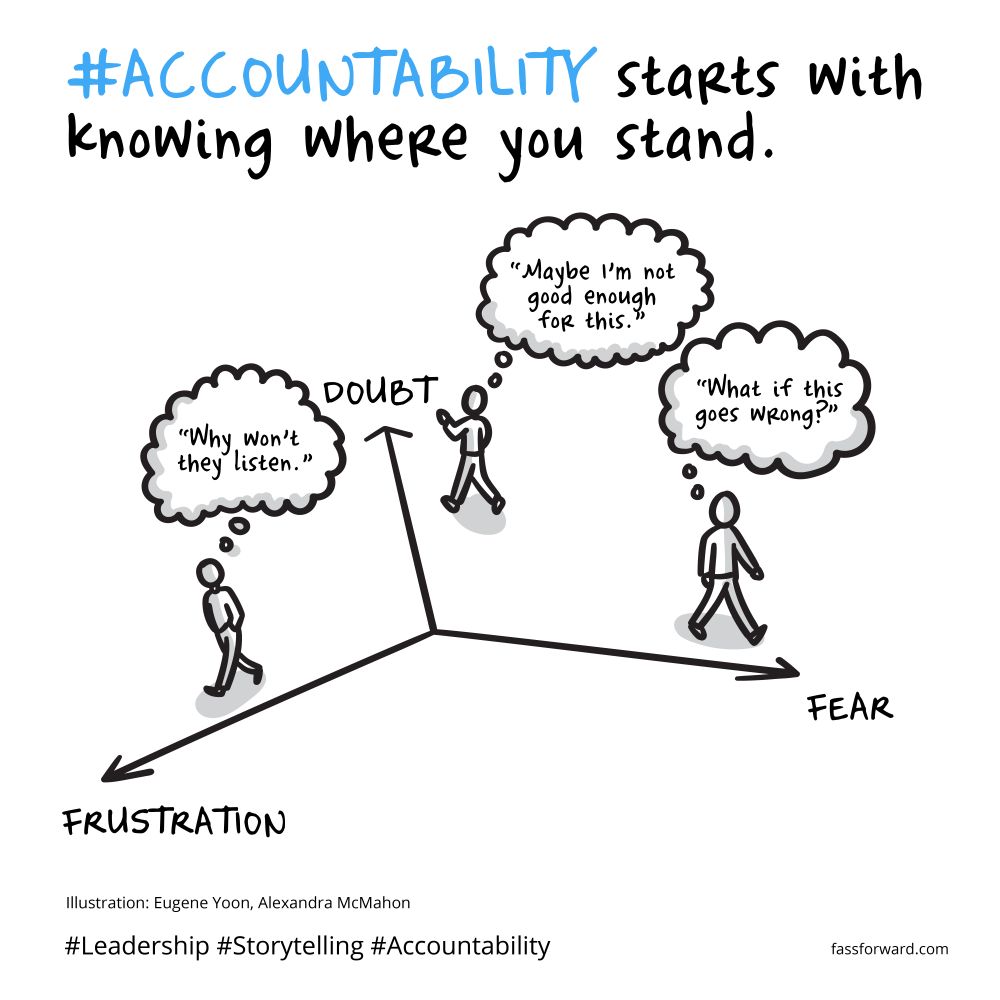
Once you see why you’re stuck, you can challenge how you’re thinking about it.
We live inside a narrative network—a web of stories that shape how we see the world and ourselves.
This isn’t just a metaphor; it’s how the brain works. Our brains create meaning through stories, filtering experiences to fit the narrative we already believe. And in that network, we’re always the hero of our own story.
But sometimes, that story works against us.
When you’re stuck in problem-reacting, the story sounds like:
The Victim: “This is happening to me.” → You feel powerless.
The Fighter: “This shouldn’t be this way.” → You resist but stay stuck.
The Doubter: “Maybe I’m the problem.” → You hesitate, unsure of what to do.

Outcome-creators rewrite the script.
They don’t ignore reality—they challenge their interpretation of it. They MacGyver it. You can do the same. Don’t say, “I don’t have what I need.” Instead of fixating on what’s missing, ask:
“What else could be true?”
“How can I make this work with what I have?”
“If I were the hero of this story, what would I do next?”
Because the moment you change the story, you change what happens next.
When you’re stuck in problem-reacting, the problem is all you see.
You’re zoomed in too close, tangled in details, emotions, and frustration. You react instead of seeing the bigger picture.
Inside the problem, you spiral—fixating on what’s fair, chasing the next big idea, reacting to the immediate, or pushing forward to stay busy.
Outcome-creators zoom out. They shift from reacting to seeing clearly:
“What’s actually happening here?”
“What hard truth do I need to face?”
“What options are there to move this forward?”
“What’s the right thing to do, beyond what’s easy?”

When you rise above the problem, you stop reacting and start solving.
This is where accountability becomes collective.
In problem-reacting mode, people protect themselves—pointing fingers, deflecting blame, or waiting for someone else to take the lead. The result? Gridlock, frustration, and slow progress.
They bring up history. Looking backward—We’ve tried that before or That won’t work here. The past is data, not a destination.
Outcome-creators face forward. They don’t re-litigate history—they focus on now. They focus on the next step, not the last failure.
Shift accountability from blame to ownership. Instead of:
Shift from “Who’s responsible?” to “What can we do to move this forward?”
Build upon common ground:
“What do we want to accomplish together?” or “What are our shared goals?”
Forward beats backward. Ask:
“What’s possible?” or “How could we do this differently?”

Momentum beats motion. Action beats activity. Together beats alone.
There is no big bang.
Except for, maybe, The Big Bang. For the rest of us, big things don’t start big. They start small.
Start with a standard domino and line up twenty-nine. If each domino is progressively bigger, you could topple the Empire State Building. Momentum scales—but only if you start.
So, why haven’t you?
If being accountable means making something happen, you must push over the first—small—domino. In problem-reacting mode, we hesitate. We don’t see the first move, or we wait—for the perfect plan, more information, or someone else to step in.

Outcome-creators don’t just start—they start in the right direction. They work backward from the outcome and ask:
“Where do I want to end up?”
“What’s the last domino—and what needs to fall before it?”
They shrink the problem. They lower the bar. They just start. They ask:
“What’s the simplest action I can take right now?”
“How can I make progress in ten minutes?”
“What’s the first domino?”
The first step doesn’t solve everything. It starts something. Tip the first domino, and momentum takes over.
Don’t be fooled by a flurry of actions.
Activity disguised as accountability is a fool’s productivity. Taking accountability means sustained impact. The first step matters. So does the second. But it’s the combination, speed, and direction that count.
The real test? Each step must lead to something bigger.
In problem-reacting mode, people act without alignment. They fix—and feel good—in the moment, but nothing really changes.

Outcome-creators think systemically. They don’t just solve problems—they connect dots, create patterns, and build for the long term. They align actions with strategy, effort with OKRs, and execution with the bigger picture.
They ask:
“Am I working on a task—or shaping something bigger?”
“How does this action fit into the larger strategy?”
“What ripple effects will this create?”
“Who else needs to own this to keep it going?”
“How will we check back in to reinforce accountability?”
Big change doesn’t happen alone. Sustained accountability rallies a team. A movement. It aligns people to a common goal—and makes something happen.

I’ve sat in a room and watched this happen:
CEO: “Where are we on ________ project?”
CXO: “Well, we’re [long, fluffy explanation that sounds close but doesn’t match reality.]”
This kind of exchange happens more than you’d think.
Someone asks for an update. Because: coordination debt—the message didn’t get through. The project lead had spoken to the CXO days earlier—but she hadn’t distilled her update into a clear, condensed, and sticky message.
The result? When it mattered, the response was long-winded, half-right—and a missed opportunity.
Managers and executives—leaders—spend the bulk of their time doing two things: making choices and communicating them. Somewhat bizarrely, while the communication side of the job is as big— if not bigger—than the decision-making, leaders aren’t born communicators.
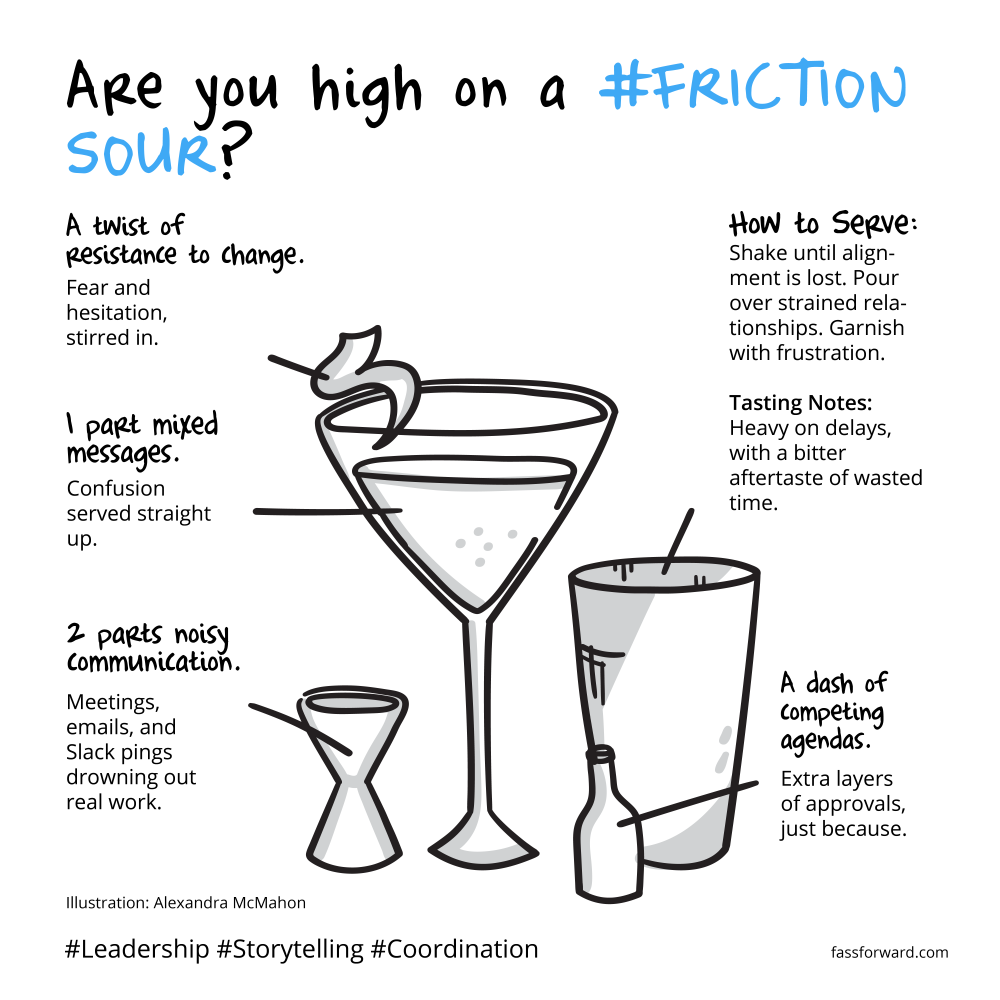
Friction in an organization is one part mixed messages, two parts noisy communication, and a dash of competing agendas.
Not everyone suffers from the pounding migraine of miscommunication.
Certain disciplines have mastered the art of lean messaging—putting words that are clear, condensed, and sticky in a useful order.
In moments that matter, the message lands.
Writers labor over six-word stories to create narratives with brutal efficiency. In six words, they are a piece of microfiction—capturing the imagination.
A satisfying six-word story suggests more than it tells, evoking emotion, tension, or curiosity. More than a short list of unrelated words, more than a tagline or phrase, they suggest a deeper story—a masterclass of minimal storytelling.
The classic For sale: baby shoes, never worn is often misattributed to Hemingway, although its original author is lost to us. They are complete implied stories.

Six-word stories master compression—saying more with less.
Journalists sharpen headlines to capture breaking news in a single phrase—short, attention-grabbing summaries designed to inform with accuracy.
A great headline isn’t vague or clickbait. It’s clear and factual, without exaggeration, distilling the essence of the news event.
Assassin Kills Kennedy: Lyndon Johnson Sworn In strips a world-shaking moment to its core, ensuring the audience instantly grasps the news.

Headlines deliver clarity—cutting through complexity with precision.
Screenwriters refine loglines to sell a movie in one sentence. They are a short summary of a film or TV show that captures the dynamics of the story, setting up the protagonist, goal, conflict and stakes.
A good logline is intriguing. It’s not a tagline or a complete plot summary. It’s just enough to give essential information and create a hook that sparks curiosity.
A small-town sheriff must stop a monstrous great white shark that is terrorizing a beach community before it kills again (Jaws); sets context: the hero, the villain, and the stakes.

Loglines prompt action—building urgency and motivation.
Scientists and engineers distill equations and laws that define how the world works. They are concise mathematical or verbal expressions that render a fundamental truth of the universe.
These equations and laws possess the same fundamentals. They are precise distillations of evidence and observation which can be applied specifically and universally.
Force equals mass times acceleration. That’s why a slap from slow-moving gorilla will hurt as much as being hit by a fastball. That’s not theory, philosophy, or hypothesis; it’s provable scientific fact.

Equations and laws define universal truth—simply expressing fundamental realities.
Investors and strategists employ rules of thumb to simplify decision-making. They are simple, practical guidelines that pack wisdom and experience into general advice.
They’re not hard-and-fast rules—more direction than law. They’re also not infallible. There is always an exception to the rule. But they are useful: easy to remember and apply.
Applying sell what the market wants won’t give you a guaranteed outcome. Markets, businesses, and people are broadly predictable but singularly erratic. A rule of thumb is an imprecise doctrine, not a deeply technical strategy.

Rules of thumb offer practicality—guiding smart, everyday decision-making.
Pundits and politicians pen soundbites to shape history and public opinion. They are rhythmic earworms; short, memorable phrases used in speeches, political messaging, or legal writing to succinctly capture a key idea.
Good ones are catchy, not cliché. They punch above their weight—sharp, repeatable, and built to last. A word steak, not a word salad.
I have a dream. Four short words that are emblematic of a vision for civil rights and a better future. That’s the power of a soundbite.

Soundbites create memorability—sticking in people’s minds.
If others do this, why does your executive summary weigh in at 800 words? Novelists can craft stories in just six.
Journalists can write headlines that inform millions, yet your strategy remains a mystery to most.
Screenwriters can pitch their product idea in one sentence. You struggle through a twenty-page deck.
Scientists and engineers distill universal truths. Your insights drown in a sea of noise.
Investors and strategists use quick rules of thumb to make billion-dollar decisions—while your team debates decision rights for weeks.
Pundits and politicians move people with soundbites. Your PowerPoint deck moves them to check email.
The answer is clear: small, sticky, frugal words.
Ideas compressed and condensed, not by font size, but by clarity. Simple rules. Hard-won experience. Practical wisdom—packed into a single sentence.
A focus line.
Something like:
Big ideas need small, sticky words.
I have taken over 800 words to get there. An idea I could have landed in six—shame on me.
Let’s check it.
It’s clear, like a headline. Sharp, like a soundbite. Compact, like a six-word story. Actionable, like a rule of thumb. Sets the stage, like a logline. Universal, like an equation or law.

You have big ideas. You have moments when you need to set context—to frame a discussion, a decision, or challenge.
You frame a narrative, controlling how the message lands, internally or externally. Once a decision is made, you must make it clear—aligning the team on the final call. You want to reinforce values or priorities. You want to drive urgency or execution.
As a leader, you must tell stories that share context. And you need to do all that in a nutshell.
You need a focus line.
Take what you know and compress it. Strip away all the big words and make it clear. Replace the sterile, corporate speak with appealing earworms. Use it to drive action. Make it repeatable to drive Message Discipline.
Turn what’s important into a focus line.

Movements don’t start with a lone leader; they start with the first follower.
In Derek Sivers’ TED Talk, How to Start a Movement, he demonstrates this idea... a now-famous video where a lone dancer awkwardly gyrates at a music festival. The crowd looks on, unsure. Then, someone joins him.
Sivers explains, “The first follower transforms a lone nut into a leader.” Soon, a third dancer joins, then a fourth, and before long, the crowd becomes a movement.

If change is about people, that is what we are looking for—a movement. Creating one is messy, unpredictable, and often uncomfortable. But with the right actions—knowing where people stand, finding your early adopters, and building momentum—you can turn skepticism into support and resistance into progress.
Here are six practical rules to turn resistance into support and create a movement.
#1. Map where people are—and remap.
#2. Tell Story 1 and Story 2.
#3. Find the second person.
#4. Go outside to come inside.
#5. Keep talking about wins.
#6. Use OKRs to stay on track.
Change is a journey.
If you don’t know where people stand, how can you move them forward? The change spectrum is your map—it shows who’s resisting, who’s neutral, and who’s on board. Your job is to shift people to the right.
Wishful thinking won’t cut it. You need real data. Some methods are fast and loose, others take longer but give you depth.
However you do it, visualizing is key. The map makes it real. It’s the “you are here” sign when you’re lost.

✅ Run quick “temperature checks.” Forget long surveys. Ask people in one-on-ones or quick Slack polls, “How are you feeling about this change today?” Patterns emerge fast.
✅ Make progress visible. Use a whiteboard, dashboard, or sticky notes to track shifts—who’s in, who’s hesitant, who’s stuck. Track movement over time.
✅ Hold “listening sessions.” No slides, no agenda—just space for people to talk. Resistance has roots. You must find them.
❌ Assuming you’re done. People shift. Resistance today doesn’t mean resistance tomorrow. Keep checking in.
❌ Overcomplicating it. Speed beats science. A gut check is often better than a 50-question survey.
❌ Admiring the problem. A map is only useful if you’re going somewhere. The next step is to act on it.
Change is a story.
Story 2 paints the picture of where you’re going. What’s possible—a future that’s better, faster, and worth the effort. Story 1 charts the path to get there—small acts that build into big change.
Story 1 is the how and the when; Story 2 is the what and the why.
People don’t move on facts alone. Emotion first, logic second. Story 2 builds belief. Story 1 builds momentum.
The best leaders use both to connect the dots, set the tone, and push change forward.
At its core, Story 1 and Story 2 are a message stack—the core messages and message discipline that frame change. They give people a way to see themselves in the picture. Better than raw information—they make change something people can feel. Crack that, and people don’t just understand change. They know what to do and how to do it.

✅ Show before-and-after. Snapshots make the contrast clear. How things are now (slow, painful, broken) vs. how they will be (faster, easier, better). Show the gap.
✅ Make it personal. It’s not “the company”; it’s us. Show how this change helps real people—sales closing faster, bugs fixed sooner, and a hassle-free customer experience.
✅ Encourage fan fiction. Let others tell the story. A PowerPoint won’t move the needle. People trust their peers. Find influencers who can share how the change is working.
❌ Leading with spreadsheets. Data backs up the story—it doesn’t replace it. If you start with numbers, you lose people.
❌ Separating change from day-to-day work. Story 1 and Story 2 must feel real—not like some side project. If people can’t see how the change connects to their daily work, they won’t engage.
❌ Thinking one story is enough. People need reminders. Keep telling the story. Keep connecting the dots. Change is a campaign, not a one-time announcement.
Movements don’t start alone.
They need a spark—someone who steps up with you and inspires others to follow. Find that second person. Then the next, and the next. Somewhere in that string of ‘nexts’ is a tipping point—the moment resistance flips into momentum.
The first follower matters as much as the leader—they validate the movement and make it safe for others to join.
You must spot early adopters and put them front and center. This is not just about influence—it’s about social and political capital. Who do people trust? Who do they listen to?
It’s about connectors—who connects teams, bridges functions, and makes things happen?
These are the people who turn isolated change into a movement.

✅ Pair up hesitant employees with believers. Peer influence is stronger than a top-down directive. A nudge from a respected colleague goes further than a mandate.
✅ Start small, then scale. Get momentum rolling with one team, then expand. It’s easier to spread change when there’s proof it works.
✅ Give early adopters something to own. Let them shape how the change rolls out. When they have a stake in it, they’ll pull others in.
❌ Thinking title means influence. Sometimes, the most powerful changemakers have no official authority—but everyone listens to them.
❌ Playing favorites. You highlight early adopters because of what they do, not who they are. Pick based on action, not personal preference.
❌ Trying to convert the unconvertible. Don’t waste time forcing skeptics to buy in. Focus on the movable middle—they just need a push.
Change doesn’t happen in a vacuum.
The people inside your organization aren’t just influenced by internal conversations—they’re watching what’s happening outside. Talking about the change beyond your walls—to customers, partners, or the market—shapes perception and builds momentum. It signals commitment, reinforces urgency, and makes it real.
Push and pull—push change from the inside and pull it in from the outside.
When change is visible externally, it feels inevitable internally. To do that, you have to flip the perspective—ask: If we were an outsider looking at our company, what would we say?
And bring in external disruptors—voices from outside the industry, startup founders, or competitors-turned-advisors—to challenge thinking and shake up the status quo.
Timing matters. Press previews—conversations with industry experts, analysts, and SMEs ahead of major announcements—can prime the market for your message. When the change goes public, they’re already echoing and reinforcing the story.

✅ Talk about the change publicly. Announce it to customers, partners, or investors. External reinforcement makes internal commitment real.
✅ Bring in outside voices. A respected expert, a case study from another company, or even a customer’s perspective can validate the change.
✅ Use press previews to set the stage. Brief industry experts and SMEs in advance so they reinforce your message when the change goes live.
❌ Assuming internal messaging is enough. People need external proof that this isn’t just another initiative—it’s a decisive shift.
❌ Overcomplicating the message. If you can’t explain the change in one sentence, it’s not clear enough. Keep it as simple as Story 1 / Story 2.
❌ Talking but not acting. Announcing change externally creates expectations. Follow up fast or risk confusion and doubt.
Where you are is familiar. Where you’re going is not.
For this reason, change is always abstract. That is the uphill battle you face. What you have done is concrete. What you might do feels uncertain.
Change is an elastic band—you stretch and pull it, but it always wants to snap back to what you did yesterday.
Inertia, rubberized.
That’s why wins matter. They make the future feel real. They inspire, create momentum, and show people what ‘good’ looks like. Without them, change stays vague—just another initiative in a long list of priorities. File under “This too shall pass.”
Not all wins are created equal. People don’t need generic pats on the back; they need a clear path forward. Make recognition highlight real progress, not just participation. Spread it too thin, and it loses its punch.
The goal isn’t fairness—it’s reinforcing what works.
Big wins are great, but if you wait for massive milestones, momentum dies. Small wins stack. Make them visible, make them repeatable, and make sure people know exactly what success looks like.
Then, they know how to follow.

✅ Celebrate the outcome, not just the effort. Trying isn’t the goal—impact is. Highlight wins that show real change: faster workflows, better customer experiences, and less friction.
✅ Tie every win back to the message stack. Story 1 and Story 2 don’t stop after the announcement. Reinforce them by linking every success back to the bigger narrative of change.
✅ Make wins shareable. Encourage teams to post their successes—on Slack, in newsletters, or all-hands meetings. Let people see progress happening in real time.
❌ Praising for fairness instead of impact. Recognition isn’t an equal-opportunity program. Highlight the wins that matter—real progress, not just participation.
❌ Only celebrating the finish line. Change is a marathon—if you don’t acknowledge progress along the way, people stop running.
❌ Keeping wins vague. "Great job, team" isn’t enough. Create a pattern. Show exactly what success looks like so others can follow.
Change is messy. OKRs bring clarity.
They keep teams focused, aligned, and accountable. Without them, change drifts—priorities get muddled, momentum fades, and people default to what’s familiar.
Good OKRs act like guardrails, keeping change on course.
But OKRs aren’t just about setting goals. They’re about managing work. They turn strategy into execution, shifting the focus from "what we want to do" to "what we’re doing right now." Used well, they create a rhythm—a system that keeps change moving.
You have to live by them too.
You cannot disconnect them from real priorities or have them cover half the work. When change stalls, it’s not because teams are busy—it’s because focus shifts. Prioritization is everything. OKRs should force trade-offs. If new must-dos emerge, drop something else.
And forget about hitting 100%.
OKRs should stretch teams, not punish them. If you hit every OKR, you’re playing it safe. If you hit none, the system is broken. The key is tracking progress early and often. If you wait until the end of the quarter to check in, you’ve already lost.

✅ Make OKRs about action, not aspiration. A good OKR doesn’t describe what you hope will happen—it defines what will get done. If it’s vague, it’s useless.
✅ Force hard trade-offs. If everything is a priority, nothing is. When a new must-do emerges, drop something else. OKRs should make choices, not add to the pile.
✅ Track progress in real-time. OKRs aren’t a quarterly exercise—they should live in weekly standups, dashboards, and decision-making moments. If you're not adjusting along the way, you’re already behind.
❌ Confusing OKRs with task lists. OKRs measure outcomes, not activity. "Launch a training program" is a task. "85% of employees adopt the new system by Q2" is an OKR.
❌ Watering them down. If every OKR is at 100% by the end of the quarter, they weren’t ambitious enough. Stretch goals drive real change.
❌ Letting OKRs collect dust. They should live in people’s heads. If they only show up in quarterly reviews, they’re already irrelevant. They should drive action, not a report card.

Change is...
An opportunity. It enables growth, innovation, and reinvention.
In business, change is...
Inevitable. To misquote Bob Dylan, “If you're not busy living, you're busy dying.” Change is going to happen. Business has to change, to grow, to compete. That’s the why. Then comes the who, where, what, and how of change.
Which means change is...
A choice. Organizations, teams, and leaders decide how to respond or adapt to change. This is not easy.
Change is...
Disruptive. It creates uncertainty. The stomach churns. Brows sweat. Teams feel unsettled or, worse, overwhelmed.
Change is...
Hard. It disrupts people, systems, and processes. Yet because it’s an opportunity, because it’s inevitable, leaders make a choice: to drive through the disruption.
Because, in the end, Change is...
Growth.
To lead through change, you need to know where people stand—what they think, how they feel, and what they’re doing. Everything comes back to this: getting people to see things differently so they can do things differently.
The change spectrum helps you do just that.

It’s a roadmap for identifying behaviors—who’s resisting, who’s supporting, and who’s on the fence—and with it, six practical rules to help you lead change.
The Change Spectrum maps where people stand in relation to change.
Clarity is the name of the game. Understanding behaviors—who’s resisting, who’s on the fence, and who’s actively supporting. With this transparency, you can guide people forward, turning hesitation into hope.
Digging underneath opposition may sound familiar.
In some ways, the Change Spectrum mirrors the Kübler-Ross Stages of Grief—Denial, Anger, Bargaining, Depression, and Acceptance—it recognizes resistance and accepts that progress through change isn’t always linear.
In understanding the Diffusion of Innovations, Rogers grouped people into categories—Innovators, Early Adopters, and Laggards—based on their behavior toward new ideas or technology. Similarly, the Change Spectrum maps behavior, not just abstract attitudes.
Where the Change Spectrum stands out is in its simplicity and practicality.
Traditional change models like ADKAR (ProSci) are mechanical, step-by-step systems for guiding individuals through change. Useful, sure, but often overly detailed for leaders managing large teams. Lewin’s Change Model—Unfreeze, Change, Refreeze—feels rigid. It describes broad organizational shifts but doesn’t offer much in the way of practical steps.
The Change Spectrum is different.

A focus on observable behaviors—what people are doing, not just what they think— simplifies complexity, mapping everything along a single axis: resistance to support.
Leaders see where people are, where they need to go, and how to help them get there.
Resistance to change is as predictable as gravity—and it’s valid. People don’t push back just to be difficult; they have reasons. Those reasons fall into four clear buckets:
The gut reaction: These are the psychological reasons—loss aversion, fear of the unknown, and clinging to comfort zones.
The mental block: Stems from overthinking—overload, confirmation bias, and mistrust of leadership.
The heart and the herd: Emotional and social triggers drive this—loss of control, identity threats, and group resistance.
The roadblocks: These are the tangible obstacles—missing tools, poor communication, and logistical barriers—that make change harder than it needs to be.

These are psychological—the instinctive feelings that bubble up when change looms.
Loss aversion: People fear losing what they value—status, stability, expertise—and the pain of loss cuts deeper than the pleasure of profit.
Fear of the unknown: Uncertainty breeds anxiety. People hesitate to take the leap when they can’t see what’s on the other side.
Comfort zone bias: Change disrupts the familiar, and even flawed routines feel safer than the uncertainty of the unknown.

This is the brain—overthinking, slowing things down, or rejecting new ideas.
Overload and complexity: Too many changes—or poorly introduced ones— overwhelm. Chaos triggers resistance as a defense mechanism.
Confirmation bias: People filter new information through their existing beliefs. If they think the change won’t work, they’ll find reasons to prove it.
Mistrust of leadership: If people don’t trust the messenger, they won’t trust the message. Even great ideas fall flat without credibility.

These reasons come from the heart—and from others around you. Resistance often stems from emotions and the influence of others.
Loss of control: Top-down change can leave people feeling powerless, as if it’s being done to them, not with them.
Identity and status threat: Change that challenges someone’s role or expertise can feel like a personal attack.
Social dynamics: Resistance spreads when vocal skeptics take the lead, pulling others along—even those who might not fully agree.

These are the nuts-and-bolts barriers that make change harder than it needs to be.
Insufficient clarity and resources: Poor communication, lack of training, or missing tools leave people feeling unprepared and overwhelmed.
Past failures and skepticism: A history of false starts or failed initiatives breeds fatigue and cynicism. “We’ve heard this before,” with extra eye-roll.
Perceived unfairness: Change that feels one-sided—benefiting some while burdening others—fuels resentment and resistance.

To put the Change Spectrum into action, to move people from the resistor column to the supporter column, requires persistence and clarity.

These six rules aren’t abstract theories or rigid playbooks. They’re practical tactics to help you lead change:
#1. Map where people are—and remap.
Start by mapping where people are—and keep mapping. Resistance shifts, neutrality evolves, and support grows. Knowing where people stand helps you adapt as you go.
#2. Tell Story 1, and Story 2.
Stories make change relatable. Story 1 explains the urgency—what’s broken and why it matters. Story 2 paints the picture of where you’re headed—a future that’s better, brighter, and worth the effort.
#3. Find the second person.
Movements don’t start alone. They need that first spark—someone who steps up and inspires others to follow. Find the second person. Then the next, and the next.
#4. Go outside to come inside.
The people inside your organization are influenced by what’s happening outside it. Talk publicly about it—share it with customers, announce it to the market. Make it real. External signals strengthen internal resolve.
#5. Keep talking about wins.
Wins are your fuel. They keep the energy alive. Celebrate every positive outcome—big or small—because every success builds belief and momentum.
#6. Use OKRs to stay on track.
Change is messy, but OKRs bring focus. Clear objectives and measurable results align teams, track progress, and keep everyone lined up and moving forward.
Driving change is hard but possible.
These six rules turn the Change Spectrum into action—helping you move people forward, one step at a time.

Maybe you’re swimming in coordination debt, frustrated with delayed decisions, bottlenecks, and duplicated efforts. Maybe you’re almost in the clear.
Whatever the reason, it's time to eliminate your debt.
Coordination debt is the friction and inefficiency that accumulates when teams struggle to align their efforts. Left unchecked, it undermines trust, slows decision-making, and leaves organizations gasping for progress.
The route to debt-free? Make your work visible, communicate clearly and concretely, and understand what you signal. This will make your team and others more aligned, productive, and engaged.
Fix it with these six rules:
#1. Define who owns what.
#2. Master the political game.
#3. Decide less; do more.
#4. Make work visible.
#5. Align on outcomes.
#6. Signal trust.
Clarity helps. Without clear ownership, work duplicates, hand-offs stall, and confusion spreads. Ownership drives action, eliminates overlaps, and streamlines hand-offs—fewer hand-offs mean fewer errors.
A tried-and-true framework like RACI works as a rulebook, but I’ve found that the terms often trip people up. What’s the difference between Responsible and Accountable? Few know—most use them interchangeably. Consulted and Informed? Often seen as a way to keep people happy in the pecking order, ensuring no one feels left out. Here’s how it really works:
Responsible are the doers; putting in the sweat.
Those Accountable are driving the work—a nice way of saying who gets blamed if everything goes wrong.
If you’re Consulted, it is more than a fly-by; it’s an expectation of valuable input.
Being Informed ensures no one is blindsided and allows them to coordinate their work in parallel with yours.

Tip: At the start of a project, map out a RACI to clarify who does what. Share it widely and keep it alive—document decisions so everyone knows who’s doing what and by when.
Just because you’ve nailed the meeting or have an impressive project plan doesn’t mean everything will work. In most organizations, informal networks—the political sphere—often dictate how things really get done. Competing agendas, lack of air cover, and poor timing can leave you drowning in coordination debt.
The C and I from RACI can help. This is where you can understand stakeholders, align priorities, and build coalitions that move work forward. Knowing who influences who allows you to unblock bottlenecks. Real relationships reduce friction, and anticipating resistance helps you address blockers before they derail progress.
Just because the technical part of work is good to go doesn’t mean you’re finished. Know who the key stakeholders are and what matters to them. Identify blockers early and address their concerns to prevent the build-up of coordination debt.

Tip: Use a ‘walking-around’ deck. Create a few slides that explain the core elements of your initiative or idea. Keep it deliberately rough—wet paint. Your job with the key stakeholders—the C and I —is to actively solicit their input and support. Let them tweak your idea and put their thumbprint on it.
This happens: A meeting meant to make decisions spirals into constant deliberation. Although I love the book, Simon Sinek launched a thousand endless conversations when he wrote Start With Why. The subtitle should’ve been: Once you’re done with that, make a decision and get on with it.
You see the signs: the meeting after the meeting, decisions in backchannels, side conversations, or grumbles about decision rights. Instead of moving forward, a stuck loop of second-guessing and overthinking.
Coordination debt grows when decisions linger. The antidote? Simplify decision-making and shift focus to action. A decision without execution is no decision at all.
Make decisions cleaner. Limit the voices at the table—fewer people mean fewer debates and faster decisions. Be clear about who decides, who contributes, and who needs to be informed. Ambiguity over decision rights fuels backchanneling, so eliminate it upfront.
Close the loop. Decisions don’t stick without follow-through. Every meeting must end with three things: who is doing what, by when, and how progress will be tracked. When everyone knows the next steps, there’s less room for confusion or excuses.
Act faster. Avoid getting stuck in pursuit of perfection. A “good enough” decision made quickly is often better than a perfect one made too late. Pilot small actions, evaluate their outcomes, and adjust as needed. Action beats inaction every time.

Tip: It may feel petty or pedantic, but summarize the decision in real-time and make sure it is written down for all to see. At the end of the meeting, clarify the what, how, when, and who attached to each decision.
Everyone has secret work. That’s not meant as a slight—it doesn’t mean you’re cagy or evasive. It simply means you have work that’s hidden from others, unintentionally adding to coordination debt. Transparency is the antidote.
Coordination debt thrives in silos. Hidden efforts—whether accidental or intentional—create misalignment, duplicated work, and missed opportunities. It’s not just about what you’re working on but when you’re doing it. By making both visible, you allow others to coordinate around you, avoid surprises, and eliminate friction.
Shine a light on secret work. Use shared tools, like calendars and project boards, to signal what you’re doing and when you’re doing it. Calendars aren’t just for meetings—they show when key work is happening, helping others coordinate.
Keep teams in sync. Short rituals like stand-ups keep priorities clear. Share what you’re working on, what’s blocking you, and where you need help. Done consistently, they reduce confusion, improve alignment, and build momentum.
Make work visible across teams. This is the hardest gap to close. Across functions and organizations, alignment comes from relationships, shared tools, and regular updates. Cross-functional syncs and project boards ensure transparency, reducing surprises, duplication, and delays.

Tip: If you haven’t started weekly stand-ups, do it. Keep them simple: “Who’s doing what?” and “Who needs help?” Get everyone on the team into a discipline around their calendar—even if they are doing focused work, naming what they are doing and when they are doing it.
Competing goals kill progress. Unfortunately, goal setting is more usually a top-down cascade than a collaborative effort. This leads teams to focus on “my part works” or letting org charts dictate how work gets done instead of aligning around shared outcomes.
Misaligned goals are the fastest way to accumulate coordination debt.
Objectives and Key Results (OKRs) help bridge the gap between strategy and execution. They connect the what and how of team efforts to the broader organizational mission while leaving some room for teams to decide when and how they execute. It’s a framework that creates clarity, fosters collaboration, and ensures alignment without micromanagement.
OKRs clarify success. When done well, teams see a clear roadmap. They understand what good looks like and what they must do to make it happen. This ensures everyone is pulling in the same direction.
Reduce competing priorities. OKRs act as a filter, connecting tactics to strategy and reducing noise in the system. People can focus on what matters most. When conflicts arise, OKRs act as tie-breakers to resolve competing priorities and keep everyone on track.
Foster autonomy. By focusing on outcomes rather than prescribing every step, OKRs give teams the freedom to decide how to achieve their goals.

Tip: Take the time to craft, test, and run your OKRs effectively.
Trust and psychological safety go hand-in-hand. People feel they can trust the process, the people, and the system when they can be themselves. The obverse must be true. When people can be themselves, they can trust the process, the people, and the system.
Get this right; you unlock more open communication and have a springboard for accountability and follow-through.
Better yet, you reduce micromanagement and over-coordination. You’re in the Goldilocks zone of collaboration. Not too much, not too little, but just enough.
This is all about people, and it starts with you.
Signaling trust is about more than just intent—it’s about consistency. You want people to behave the same way on Team 1 (the team they are on) as they do on Team 2 (the team they lead).
On Team 1, this means showing up authentically, contributing candidly, and delivering reliably. On Team 2, signaling trust is about owning your mistakes, not shifting the blame. It’s about asking for—and being open to—input. It’s about delegating responsibility and stepping back to let others succeed.

Tip: It’s easier to signal trust on Team 2 than it is on Team 1. Because: fear and control. On Team 2, delegate. On Team 1, start by being transparent. Share what you’re working on, where you’re stuck, and where you need help. Openness begets trust.

Coordination debt is real.
It affects organizations in the way oxygen debt affects athletes: at first, invisible, then suddenly—a strain. Before long, it’s a struggle for breath, followed by a rapid breakdown in performance.
Like any debt, its effect is insidious—gradually wearing down groups until the cracks are too big to ignore.
The chronic stress of coordination debt leads to a sense of helplessness across teams. It breeds strained relationships for individuals—a lack of trust, a reduced sense of autonomy, and decision fatigue.

Unfortunately, coordination debt is natural as businesses grow.
Much like the sleep debt a parent accrues from looking after their newborn, coordination debt results from a positive thing. Growth. Which demands another positive thing—delegation.
To get work done at scale, we divide it into smaller chunks—by project, operation, and geography. Projects roll up into a roadmap, with functions—marketing, sales, product, and technology—prioritizing their own—sometimes competing— goals.
Specialization creates silos.
Geographic splits add another layer of complexity: sales teams focus on the nuances of the North East, while those in the South West operate differently. Best practices fragment. Over time, it becomes hard to tell the difference between a needless nuance and a necessary one—our attempts to grease the gears of business paradoxically gum it up.
Teams, naturally, focus on their work and ensure their part works. But friction between teams turns into small gaps, and small gaps in coordination quickly grow into full-blown silos.
At first, these gaps might seem manageable, even normal—decisions are made; work gets done—but as missed moments and poor communication pile up, the cracks begin to show. Misaligned goals, duplicated efforts, and dark deployments become the organizational equivalent of gasping for air.
The harder you try to move forward, the more resistance you face.
It’s not just coordination debt that calcifies the organization. Technical debt, process debt, and coordination debt all weigh heavily on a balance sheet. Together, they’re an invisible force—an organizational gravity—that slows change, swallows collaboration, and toxifies culture.

Closing the gap starts with understanding where it comes from.
Here are six main culprits of coordination debt.
#1. Structural cracks.
#2. Process inefficiencies.
#3. Collaborative overload.
#4. Cultural erosion.
#5. Scaling pains.
#6. Disconnected systems.
Recognizing which root cause your debt stems from is crucial. You need to unpick the tangle of hidden costs. Only then can you move forward—fixing performance, aligning work with strategy, and cultivating culture.
Ironically, dividing work to do work builds debt.
Teams chase their own objectives without considering how their work impacts others. It’s a kneejerk reaction to speed and urgency—‘it’s easier if I do it myself’—that creates its organizational twin: silos.
Over time, this leads to conflicting priorities and duplicated efforts.
Work in one area may unintentionally block progress in another. Without alignment, teams often don’t realize they’re slowing others down—or worse, different groups unknowingly tackle the same goal in isolation, wasting valuable resources.

Ask yourself: Are your teams siloed? Look for:
When overloaded, all mechanisms underperform.
The very effort to go faster creates friction that slows progress. Delays, rework, and confusion spread through unclear ownership, ambiguous handoffs, and labyrinthine workflows. Operational drag takes over.
At the root of the problem, complexity masquerades as process.
Unclear ownership of decisions—CYA—blurs into bureaucracy with too many cooks in the kitchen. Multiple hand-offs with ambiguous inputs and outputs create bottlenecks, leaving tasks adrift. Wooly communication leads to ‘dark deployments’—projects launched without full alignment, resulting in crossed wires and missed objectives.
When processes frustrate, people bypass them. Workarounds multiply, creating inefficiency on top of inefficiency, leaving teams stuck in a cycle of rework and delays.

Ask yourself: Do your processes flow—or frustrate? Look for:
The act of collaboration requires work.
And that work can be overwhelming. Demand outpaces capacity. Leaders shuffle between too many direct reports; trading time spent driving outcomes for constant coordination. Endless check-ins and updates pile up—a murder of meetings.
Firefighting becomes the order of the day.
Reactive tasks overshadow the strategic. Leaders feel stretched thin, caught in a loop of decision-making that leaves little room for deeper thinking. Time disappears, energy fades, and priorities blur. Teams lose sight of their goals, buried beneath the weight of perpetual coordination.

Ask yourself: Is your collaboration driving outcomes—or dragging you down? Look for:
Over time, coordination debt becomes a collective habit.
You hear it in a quiet mantra: “This is just how we do things around here.” Information is kept close for fear of criticism, eroding trust. Communication falters as misalignment and misunderstandings take root.
Morale takes a hit.
Distrust and constant rework stifle creativity. Employees eventually check out—they stop sharing ideas or raising concerns, worried they’ll only add to the noise. Great ideas stay locked away, progress feels out of reach, and the culture stagnates.

Ask yourself: Is your culture helping or hurting progress? Look for:
Rapid growth brings excitement—and exhaustion.
As your company stretches to meet new demands, systems, and processes that once worked begin to buckle. Teams resort to patchwork solutions, duct-taping workflows that no longer fit today’s needs.
The strain shows fast.
New employees struggle to find their footing, slowed by unclear workflows and outdated tools. Communication becomes a game of broken telephone as scaling efforts outpace the systems meant to support them. Without scalable systems, every step forward feels like a scramble to keep up. Teams are running harder but going nowhere.

Ask yourself: Are systems stretching or snapping under pressure? Look for:
In the chaos of disconnected systems, fragmentation reigns.
Picture a designer juggling six tools to complete one project—exporting data from one system, cleaning it up in another, and uploading it to a third for approval. Updates are tracked in a spreadsheet, and emails coordinate the next steps; critical information gets lost in the shuffle.
Instead of making life easier, tools tangle workflows into knots.
This leaves teams scrambling to bridge gaps. Efficiency takes a nosedive. Time is wasted toggling between platforms, copying and pasting data, and chasing down updates.

Ask yourself: Do your tools work for you or against you? Look for:
If you’re struggling with coordination debt, one or more of these culprits is likely at its heart, disarmed with well-intentioned commentary: “We’ll figure it out as we go,” or, “We’re just moving fast.” Until the roots dig deeper—stalling decisions, growing silos, and spreading frustration.
Uncover and address those roots before they take hold and choke progress.

Time is an irreplaceable resource.
Once spent, it’s gone; we can’t earn more, buy more, or magically produce more. For leaders, this truth is even more pressing.
We spend—roughly—80,000 hours in a career. Say ~10,000 hours as an individual contributor. ~20,000 hours down, and you’re in management. By the time you are twenty to thirty years into your career, you might be a vice president or knocking on the door of the C-suite. That’s another ~25,000 hours leading departments, shaping strategy, and driving key initiatives. By now, we’re setting priorities and managing the capacity of teams, departments, and functions.
Every hour is expensive.
The cost grows when you’re directing precious resources against that time. The job is simple: direct limited hours and resources to the highest impact priorities. Take one cliché and slam it against another. Time is of the essence, so we need to go after the low-hanging fruit. Or put another way: Time waits for no one, so keep your eye on the big rocks.

But how?
Whatever you’re building or selling, you and your time are spending time on four kinds of work:
#1. Core work.
#2. Critical work.
#3. Busy work.
#4. Secret work.
Core work makes the business run.
Core work maintains daily operations—"keeping the lights on"—and focuses on immediate needs, such as sustaining customer satisfaction or financial stability. It represents what you are paid to do: tasks that deliver daily value to the business, tailored to each function’s needs.
In sales, Core work is nurturing leads, closing deals, and maintaining customer relationships. Legal focuses on managing contracts, compliance, and daily legal risks. Customer service handles inquiries, resolves complaints, and ensures customer satisfaction. HR manages onboarding, payroll, and employee issues. Engineering maintains systems, fixes bugs, and keeps technical operations stable.
Core work delivers to set standards. It meets KPIs and delivers on OKRs.

How do you know if the work you are doing is core? Do this little test:
If your work serves a customer or supports someone who does—and it has an immediate (this quarter) impact—then it’s Core.
Critical work makes the business relevant.
Whether big or small, evolutionary or revolutionary, Critical work drives change, fuels growth, and prepares the business for the future. It could be a strategic initiative, innovation, transformation, new capability, or a new way of doing things—all to ensure long-term success.
Critical work in sales might involve entering new markets, developing strategic partnerships, or creating innovative sales strategies. Legal work could focus on significant compliance initiatives, navigating complex mergers, or managing high-stakes litigation. Customer service might involve developing new service models, enhancing digital support channels, or implementing new customer feedback systems. HR could spearhead organizational redesigns, leadership development programs, or culture transformation. Engineering work might focus on developing new products, enhancing system capabilities, or exploring emerging technologies.
Critical work lifts standards. It resets KPIs and delivers on OKRs.

Is your work Critical? Consider these questions:
If your work will create meaningful, lasting change and position the company for future success, it’s Critical.
Busy work doesn’t add value.
You want to minimize Busy work because it’s transactional, not strategic or tactical. These are the tasks that keep you occupied but don’t meaningfully contribute to business goals or customer outcomes. Busy work often hides in excessive meetings, redundant reporting, unnecessary emails, or low-priority administrative and bureaucratic tasks that eat away at time and energy.
Peculiarly, Busy work is often yesterday’s core work—tasks that once added value or were relevant to business success but now occupy time.

Are you occupied with Busy work? Ask yourself this:
If the answer to any of these is no, it’s likely Busy work. It’s a candidate for automation, delegation, or elimination.
You haven’t told anyone about your Secret work.
But deep down, you suspect that it will add value to the business once you figure it out. It will improve how things are done. And you genuinely enjoy it.
Secret work stems from the work people do—or want to do—that feels personally fulfilling and meaningful. Often, these are initiatives that individuals or, in large companies, small groups pursue because they believe it can ultimately add value, even if it hasn’t been openly shared or prioritized by others.
Though it may fly under the radar, Secret work is fueled by passion, curiosity, or a desire to make a difference. Too often, though, time gets in the way, pushing Secret work onto a wishlist, into a notebook, or leaving it buried in a spreadsheet—a to-do list of things that would be great if only there were enough time.

If you don’t know already, here are three questions—beyond the fact you haven’t told anyone about it—to help you identify Secret work:
If you answer yes to these questions, it’s likely Secret work—but remember, Secret work only fulfills its potential when you can share it.
I heard once, “We can’t get to the change because business-as-usual gets in the way.” That is a sign that work is out of balance—hours eaten away by Busywork. Critical work—the business transformation—pushes up against and is stifled by business as usual. No distinction is made between Core and Busywork. People are keeping on with their Secret work.
This is the formula for all failed change agendas.
Then, the not-quite-root cause of that failed change agenda is vilified. Change fatigue. Work-life balance and burnout. Culture eating strategy for breakfast. Lurking behind all these is a much more likely villain—work-work balance.

Work is out of balance when there is no distinction between Core, Critical, Busy, and Secret work.
Famously, some companies have tackled this. Google’s “20% time” formalized Secret work and instituted it as Critical work as Google sought to build innovation into its culture.
McKinsey, not surprisingly, has developed a strategic framework that describes work-work balance: The three horizons of growth. Each horizon segments organizational activities. Horizon one parallels Core work; running and optimizing core businesses. Horizon Two involves emerging opportunities that need nurturing (similar to Critical work), and Horizon Three is future-oriented ventures involving experimentation (comparable to Secret work).
While that framework is in the realm of strategists, Core/ Critical is something you can apply now to make space for your team.
Time is your most finite resource and every hour matters.
You have 80,000 or less. To find time, start by distinguishing the different types of work you and your team do: Core work that keeps the lights on, Critical work that drives change, Busy work that clutters your day, and Secret work that fuels personal passion.
To free up time, get clear on the objectives of the team. Make sure your OKRs cover Core and Critical work. Ask yourself if it’s really Core or Critical. Prioritize Core work that delivers immediate value while setting aside regular blocks for Critical projects that shape the future.
Bring Secret work into the light through innovation sprints, hackathons, or dedicated passion project hours. Minimize Busy work by streamlining processes, delegating tasks, or asking others to simplify what creates friction.
This is how you find time.
