
.svg)
Free Survey
Our People
Our Thinking
Shop

Most companies don’t have a product problem. They have a value creation problem.
If growth depends on you pushing, you don’t have momentum. You have effort. And effort doesn’t scale. Strong leaders know how to build. Enterprise leaders know how to create value.
There’s a difference. product depth. operational rigor. technical excellence. Those build strong solutions. But organizations don’t scale on solutions alone. They scale on value creation.
Commercial vision is the shift from: “What should we build?” to “What creates measurable value?” Revenue. Retention. Margin. Market position. Timing. Without that lens, teams optimize for output. With it, they optimize for impact.
This dynamic surfaced recently in a coaching conversation with a Vice President of Product at a technology company. What it revealed was that two very different conversations were happening at the same time.
You can see the difference in meetings.
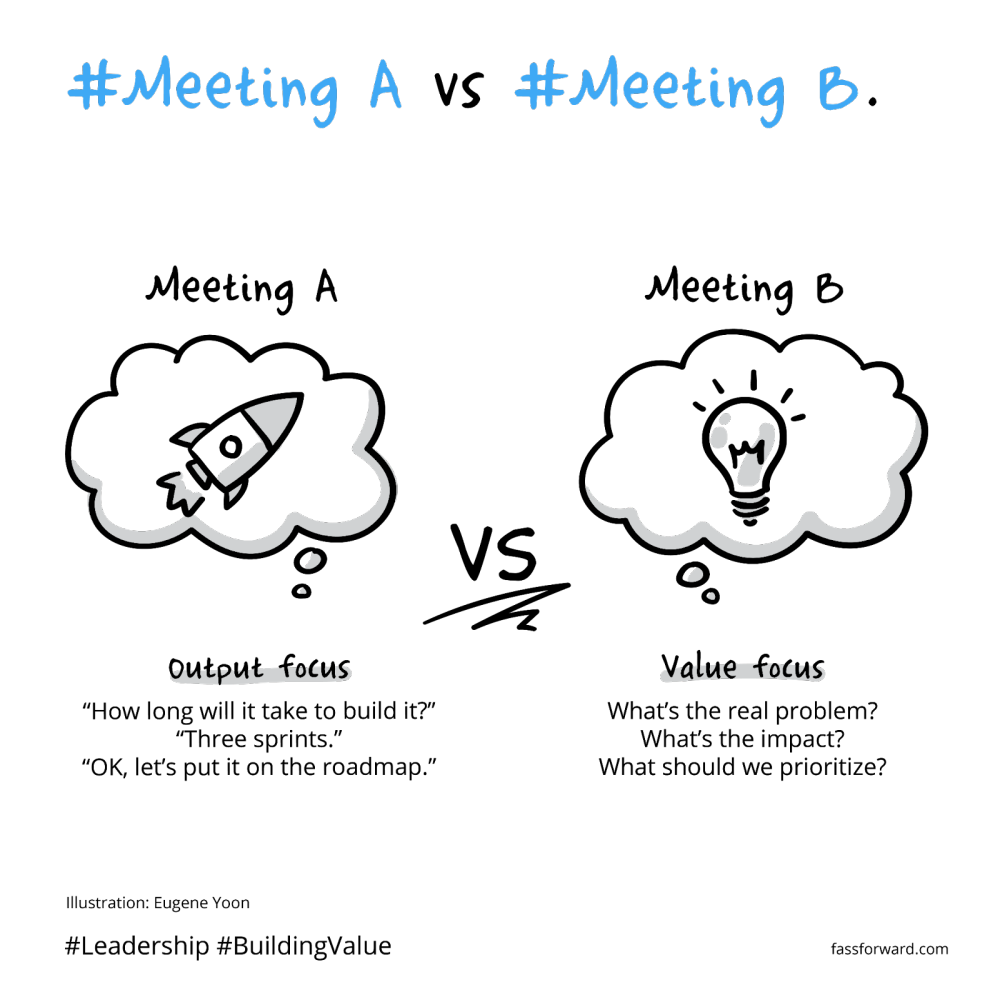
“We’re losing some enterprise deals; they want a custom reporting dashboard.”
“How long will it take to build it?”
“Three sprints.”
“OK, let’s put it on the roadmap.”
“We lost three enterprise deals; they want a custom reporting dashboard.”
“What was the value?”
“About $1.8M ACV.”
“What’s the evidence?”
“They told us reporting was the issue.”
“Is that why they didn’t sign… or what they said at the end?”
“…It came up late.”
“So what problem were they trying to solve?”
[Silence.]
“If we build this, what do we delay?”
“Improving onboarding.”
“And which one grows the whole base?”
“…Onboarding.”
Which conversation feels more familiar?
If it's Meeting A, you’re optimizing for output. If it’s Meeting B, you’re optimizing for value.
The feature/value dilemma is the difference between tactical reaction and strategic intention. Between short-term appeasement and long-term growth. A feature is output. Value is outcome. A feature answers: “What can we ship?” Value answers: “What moves revenue, retention, margin, or position?”
Organizations that scale build something different. They build value engines.
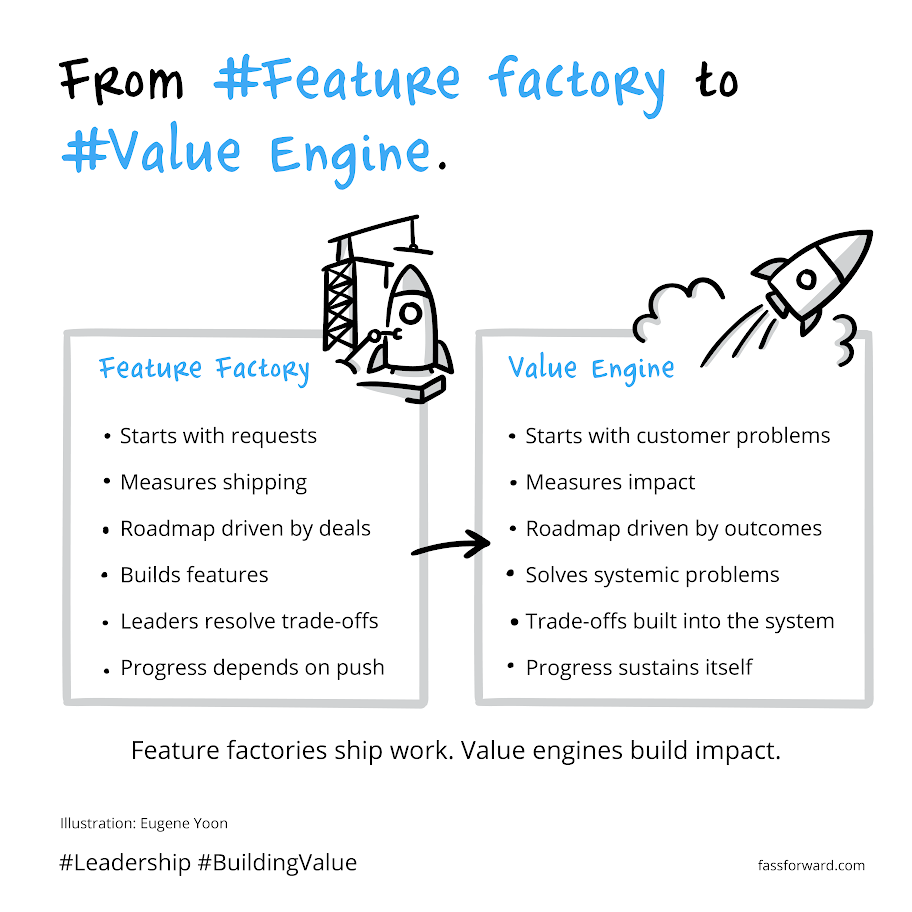
A value engine does one thing:
It converts customer problems into business outcomes. Not activity. Not features. Outcomes. Instead of starting with a roadmap, teams start with the impact they want to create.
The thinking shifts from:
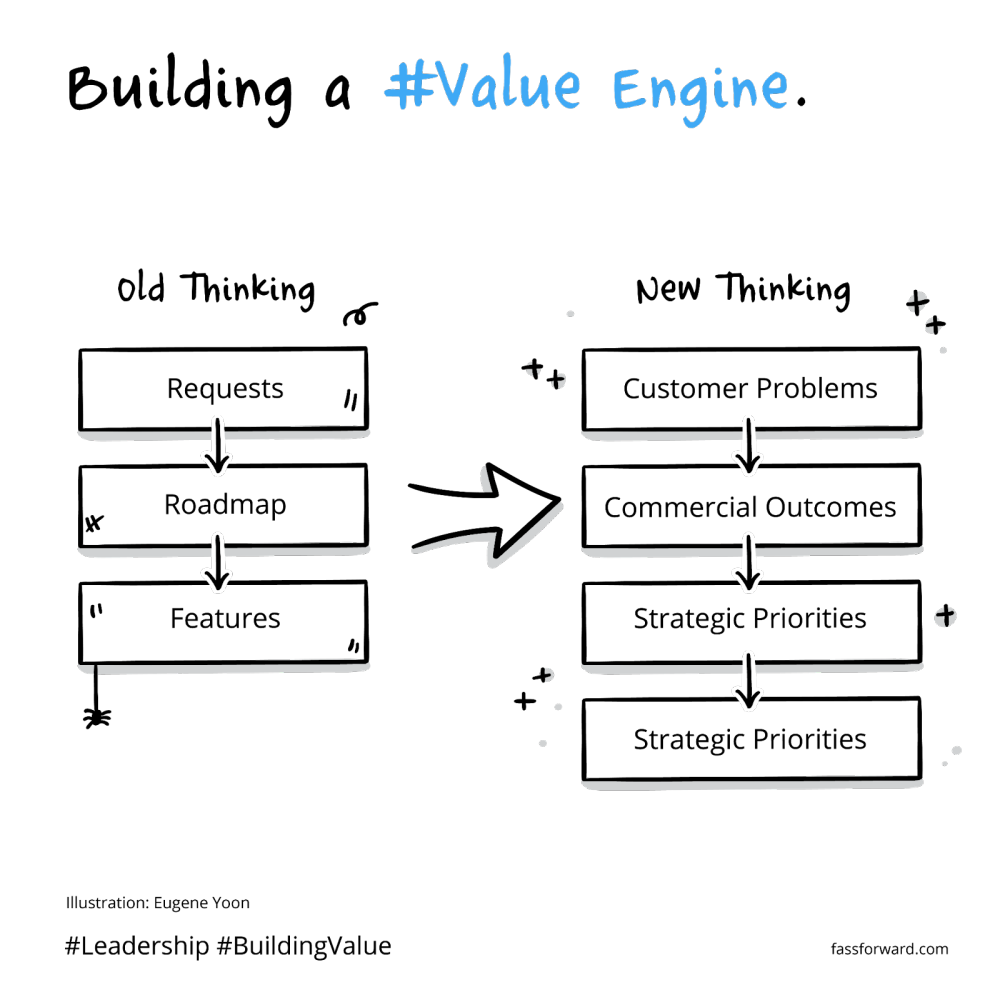
Features become tools. Value becomes the goal. Teams begin debating questions like:
Over time, value creation becomes systematic, not incidental. But most organizations never reach this point. Not because they lack talent. Because they drift into feature factories.
Three leadership habits usually cause it.
Most organizations celebrate shipping.
“We released twelve features this quarter.” “Velocity increased.” “The roadmap is full.”
Those are measures of activity. Teams quickly learn what success looks like. If shipping is rewarded, they optimize for shipping.
Value engines ask a different question.
Not:
What did we release?
But:
What changed because we released it?
Did adoption increase? Did churn decrease? Did sales velocity improve? Did onboarding accelerate?
The conversation shifts from production to impact.
A deal is lost. Sales says:
“They needed X.” Product builds X.
But what appears late in a deal cycle is rarely the root problem. It’s the final objection raised in negotiation.
The real issue might have been:
When companies build features from deal feedback, the roadmap slowly becomes a list of objections.
Value engines pause and ask different questions:
Only then does work get prioritized.
This is where scaling begins to break.
In early growth, leaders often:
It works. For a while. But eventually, the organization becomes dependent on that intervention.
Progress requires:
When they step away, momentum slows. The leader has become the engine.
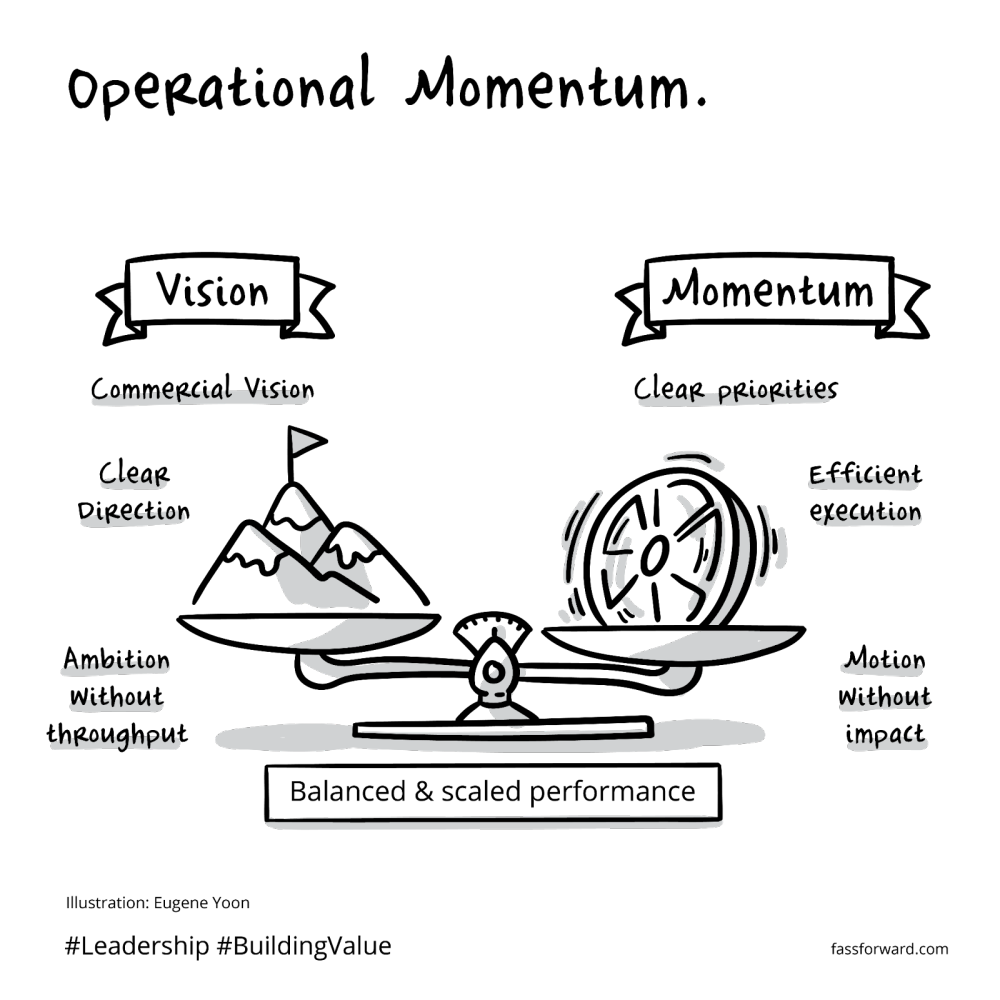
Operational momentum looks different. Priorities are unmistakably clear. Sequencing reduces friction. Decision rights are understood. Context is widely shared. Progress sustains itself. Momentum is when the flywheel turns without constant force. Commercial vision sets direction. Operational momentum sustains acceleration. One without the other creates an imbalance. Vision without momentum creates ambition without throughput. Momentum without vision creates motion without impact. Together, they separate companies that perform from companies that scale.
Ask yourself a few questions.
When a deal is lost, what happens first?
A) The requested feature goes onto the roadmap.
B) The team analyzes the underlying problem and commercial impact.
When teams debate priorities, what dominates the discussion?
A) Delivery timelines and engineering capacity.
B) Revenue, retention, and customer impact.
When you step away for two weeks, what happens?
A) Progress slows while teams wait for decisions.
B) Work continues within clear priorities and decision rights.
If most of your answers were A, you're operating a feature factory.
If most of your answers were B, you're building a value engine.
The real question isn’t whether you’re building great products. It’s whether you’re building a value engine. Because if the system slows when you stop pushing, you don’t have momentum. You have effort. And effort doesn’t scale.
Take the full survey on Typeform: https://fassforward.typeform.com/to/YMUMhQ3w

Frank Mazza is a Principal Consultant, Executive Coach, and Lead Facilitator at fassforward. He works as a coach one on one, and a facilitator with intact teams, and large organizations across a wide range of fassforward's live and online programs. Known for his ability to present familiar concepts in such a manner as to give "life" to the content and spark renewed and sustained interest.